Planet formation in chemically diverse and evolving discs II. Chemical fingerprints in planetary atmospheres

Planet formation in chemically diverse and evolving discs II. Chemical fingerprints in planetary atmospheres
E. Pacetti, D. Turrini, E. Schisano, S. Molinari, C. Walsh, C. P. Dullemond, S. Fonte, R. S. Klessen, U. Lebreuilly, P. Hennebelle, S. L. Ivanovski, R. Politi, D. Polychroni, P. Simonetti, L. Testi, V. Cottini
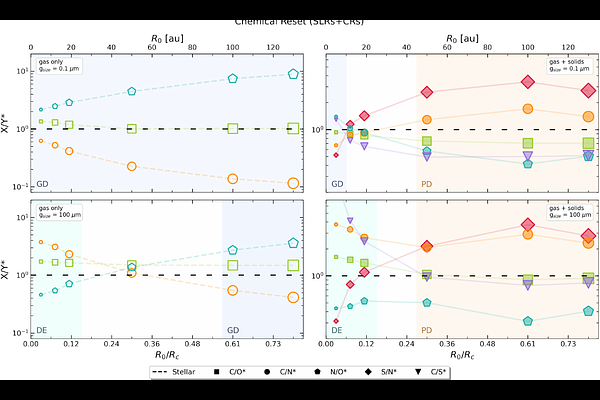
AbstractGiant planets form in protoplanetary discs, where the coupled dynamical and chemical evolution of gas and solids determines the composition of the material they accrete. We investigate how planet formation and migration shape the primordial elemental makeup of giant-planet atmospheres. Our aim is to link atmospheric compositions to planets' formation pathways and the time-dependent chemical properties of their natal discs. We couple 1D models of viscously evolving discs - incorporating radial dust drift and volatile chemistry - with N-body simulations of planetesimals interacting with a growing and migrating giant planet. Four chemical scenarios and three representative grain sizes (0.1, 20, and 100 micron) are explored. We track the accretion of carbon, oxygen, nitrogen, and sulphur to derive atmospheric elemental ratios normalised to stellar values (* denotes stellar normalisation). We identify three atmospheric classes corresponding to distinct accretion regimes: gas-dominated, characterised by N/O* > C/O* > C/N* and unconstrained or substellar S/N* (near-stellar C/S*); planetesimal-dominated, showing N/O* < C/O* < C/N*, S/N* >= C/N*, and C/S* <= C/O*; and drift-enhanced, exhibiting N/O* < C/O* < C/N* and markedly superstellar volatile-to-refractory ratios. N/O*, C/N*, and S/N* vary systematically with migration extent, although degeneracies arise for planets forming beyond the CO and N2 snowlines; C/O* remains largely insensitive. Metallicity alone does not uniquely trace the solid-to-gas accretion balance in drift-dominated regimes. Variations in the disc's chemical state and dust size imprint distinctive volatile-ratio patterns across these classes, providing complementary constraints on disc properties. This multi-element framework establishes predictive trends to guide the interpretation of atmospheric spectra from facilities like JWST and Ariel.