Transmission Spectrum of the Benchmark Temperate Exo-Neptune TOI-1231 b

Transmission Spectrum of the Benchmark Temperate Exo-Neptune TOI-1231 b
Subhajit Sarkar, Nikku Madhusudhan, Lorenzo Pica-Ciamarra, Måns Holmberg, Frances E. Rigby, Julianne I. Moses, Megan Mealing
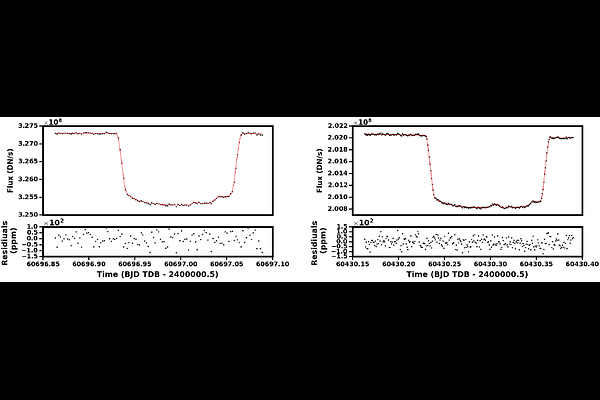
AbstractThe JWST is revolutionizing our understanding of the temperate sub-Neptune population through atmospheric spectroscopy. The nature of these planets remains debated, as their bulk properties are compatible with a range of interior scenarios, including mini-Neptunes, hycean worlds, and gas dwarfs, with different predicted atmospheric compositions. While theoretical studies have predicted compositional diagnostics for shallow- versus deep-atmosphere scenarios, there is a critical need for empirical constraints for a temperate planet that is a priori known to possess a deep H$_2$-rich atmosphere. The temperate exo-Neptune TOI-1231 b provides one such benchmark target. In this work, we present the JWST near-infrared (0.65--5.2 $μ$m) transmission spectrum of TOI-1231 b, observed with NIRISS single-object slitless spectroscopy and NIRSpec G395H, representing the first for a temperate exo-Neptune. The density of TOI-1231 b requires a thick H$_2$-rich atmosphere, making the planet a keystone reference case for testing mini-Neptune scenarios for sub-Neptunes. We report a strong detection of CH$_4$ ($\ln B = 54.5$-$69.6$) and moderate to strong evidence for CO$_2$ ($\ln B = 2.9$-$6.6$). We do not find significant evidence for any other prominent molecule, although we find high 95\% upper limits on the mixing ratios of NH$_3$ and CO, both of which are expected in deep H$_2$-rich atmospheres. We also do not find any significant evidence for sulfur-bearing species that have been inferred for some temperate sub-Neptunes. This composition is consistent with expectations for a temperate Neptune possessing a deep H$_2$-rich atmosphere with no distinct surface. We discuss the implications of our results for the characterization of temperate sub-Neptunes.