Shifts in demography in changing ecological conditions in a dependent-lineage population of harvester ant colonies

Shifts in demography in changing ecological conditions in a dependent-lineage population of harvester ant colonies
Glinka, F.; Steiner, E. B.; Privman, E.; Gordon, D. M.
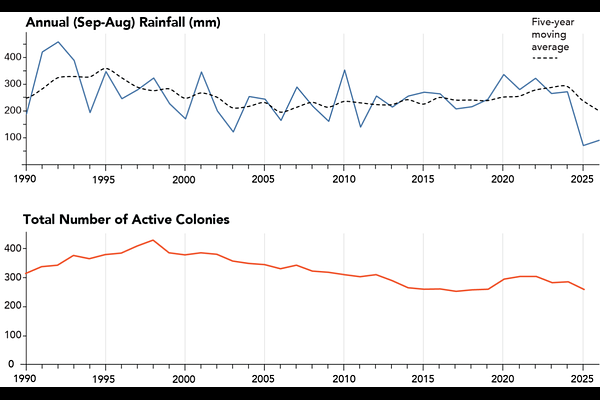
AbstractEnvironmental stress can influence population dynamics and shift selection pressures. We considered the demographic effects since 2011 of intensifying drought in a J1/J2 dependent-lineage population, monitored since 1988, of the red harvester ant, Pogonomyrmex barbatus. A queen must mate with males of both dependent lineages to found a viable colony; mating with the same lineage results in a gyne, while mating with the other lineage results in a worker. We used reduced representation genomic sequencing of workers from 407 colonies, ages 1-3, mostly sampled in 2021-23, to determine colony lineage, identify sets of colonies with the same mitotype, and estimate kinship between mother-daughter pairs. We found that the rare lineage J1 became even more rare, from 39% in 2011 to 25% in 2023. This creates pressure on J1 to produce more sperm or more males to allow the population to persist. We compared survival and numbers of offspring produced in the two lineages and in sets of colonies with the same mitotypes, using census data. Survival and fecundity were similar among 5 J1 and 6 J2 mitotype groups, showing no evidence for selection favoring any mitotype. We identified 62 mother-daughter colony pairs. These included 14 grandmother-triplets, with most grandmothers found in J2, suggesting that some families dominate each mitotype group. Within the 62 mother-daughter pairs, those from J1 tended to live longer than J2 colonies, maintaining a low but constant fecundity rate, while J2 colonies showed the highest fecundity at ages 11-17. Our results suggest that increasingly harsh ecological conditions are shaping population dynamics more rapidly than selection for phenotypic traits that could facilitate adaptation.