Multi-Scale Contrastive Attention for Light-Curve Representation Learning

Multi-Scale Contrastive Attention for Light-Curve Representation Learning
Torsha Majumder, Konstantin Malanchev, Emille E. O. Ishida
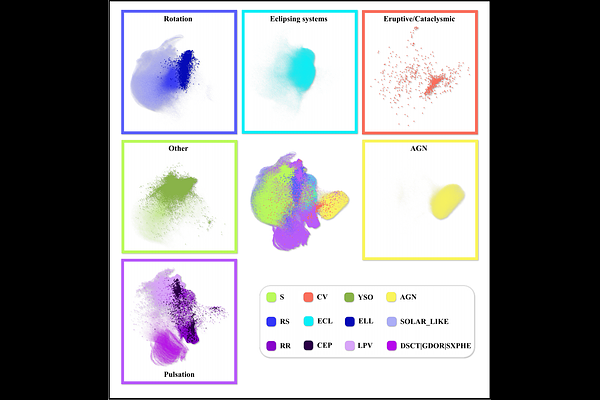
AbstractCurrent and next-generation time-domain surveys demand automated techniques capable of analyzing millions of light curves, observed in multiple filters, without relying on exhaustive human annotation or scarce spectroscopic follow-up. We present Astra-CLR, an attention-based, self-supervised contrastive learning framework which enables the representation of raw light curves into a highly discriminative latent space. Pre-trained on $\sim$2.1 million unlabeled Zwicky Transient Facility light curves, the framework utilizes partial light curves as input sequences to generate asymmetric, multi-scale temporal views (explicitly contrasting shorter sequences against longer ones) forcing the network to learn a robust "local-to-global" mapping strategy. Furthermore, we introduce a novel multi-view late fusion architecture that extends the model to efficiently handle longer light curves with larger numbers of observations while accommodating the different cadences associated with each filter. The discriminatory power of the resulting representations was evaluated by using them as input to a Multinomial Logistic Regression classifier, trained to identify 12 broad classes of variability. Final accuracy achieved $\sim 0.70$. When applying a label-efficient, partial top-layer fine-tuning strategy, the topological structure of the latent space is significantly refined, boosting results to $\sim$0.77. Astra-CLR is the first publicly available multi-filter time-series Transformer trained exclusively on real ZTF light curves. Results presented here demonstrate that it provides an ideal foundation for the development of end-to-end pipelines, taking into account color evolution and respecting the inhomogeneous nature of astronomical light curve sampling.