Unraveling Chemical Enrichment in Extreme Emission-Line Galaxies: A Multi-Element Bayesian View of Bursty Star Formation and Galaxy Evolution in DESI

Unraveling Chemical Enrichment in Extreme Emission-Line Galaxies: A Multi-Element Bayesian View of Bursty Star Formation and Galaxy Evolution in DESI
Razieh Emami, James A. A. Trussler, Tiger Yu-Yang Hsiao, Kaley Brauer, Lars Hernquist, Randall Smith, Douglas Finkbeiner, Fengwu Sun, Rebecca Davies, James F. Steiner, Mark Vogelsberger, Tobias Looser, Grant Tremblay, Letizia Bugiani
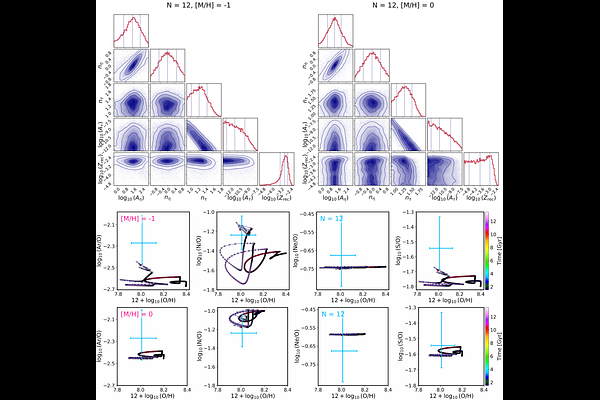
AbstractExtreme emission-line galaxies (EELGs) probe chemical enrichment in low-mass, bursty systems where star formation, feedback, and gas accretion are poorly constrained. Using DESI DR1, we select 23 nearby EELGs with detections of 19 ionic species (S/N $\geq$ 4), stellar masses $ M_* \geq 10^7 M_{\odot}$, and extreme H$α$ and [O III] 5007 equivalent widths (EW $\geq$ 500 Angstrom). We infer non-parametric star-formation histories and fit a Bayesian single-zone chemical-evolution model to O, N, Ne, S, and Ar, allowing time-dependent star-formation efficiency, outflow mass loading, and evolving inflow metallicity. We find short depletion timescales and large mass-loading factors, indicating rapid gas cycling in a burst-driven, non-equilibrium regime, with depletion times below Kennicutt-Schmidt expectations. Star-formation efficiency and outflows are well constrained, while inflow metallicity is weaker due to degeneracies with metal production. Abundance ratios isolate physical drivers: star-formation efficiency sets evolutionary tracks, outflows regulate metal retention and X/O normalization, and inflow metallicity sets baseline enrichment. N/O strongly constrains burst timing and gas flows, Ne/O remains nearly invariant, and S/O and Ar/O show intermediate sensitivity. These results demonstrate that multi-element abundances provide a direct probe of baryon-cycle processes in extreme low-mass starbursts.