Evolution of Spatial Complexity in Flare Ribbon Substructure and Its Relationship to Magnetic Reconnection Dynamics

Evolution of Spatial Complexity in Flare Ribbon Substructure and Its Relationship to Magnetic Reconnection Dynamics
Marcel F. Corchado Albelo, Maria D. Kazachenko, Ryan J. French, Vadim M. Uritsky, Emily Mason, Cole A. Tamburri, Rahul Yadav, Benjamin J. Lynch
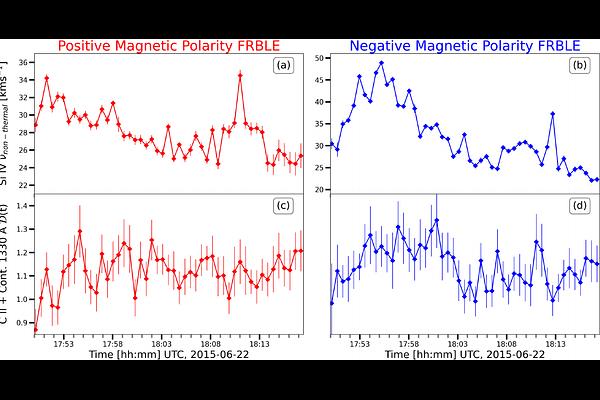
AbstractRecent three-dimensional flare models suggest that flare-ribbon substructure is linked to the fragmentation of the reconnecting current sheet in the corona. Flare-ribbon substructure can therefore potentially serve as a unique diagnostic tool for physical processes in the flare current sheet. In this paper, we describe a new method to quantify the evolution of ribbon substructure, which first extract the ribbon's leading bright front and the quantifies its morphology using the box-counting dimension and Correlation Dimension Mapping (CDM). We first test our method using synthetic observations. We then find that when the flare ribbon boundary has more multi-spatial-scale features (higher box-counting dimension), hard X-ray (HXR) emission and magnetic reconnection rates are the strongest. We also find that the flare-ribbon complexity characterized by CDM has moderate correlation with the IRIS Si IV 1402.77 Å non-thermal velocity (in the negative-polarity ribbon) and reconnection flux rates (in ribbons of both magnetic polarities). We conclude that the build-up of the spatial complexity of the ribbons at multiple spatial scales can serve as an observational proxy for current-sheet fragmentation in the corona.