Positive Affect Modulates Early Valuation and Conflict Processing in Social Decision-Making

Positive Affect Modulates Early Valuation and Conflict Processing in Social Decision-Making
Liu, Z.; Liu, Y.; Li, W.; Cui, R.; Liu, X.
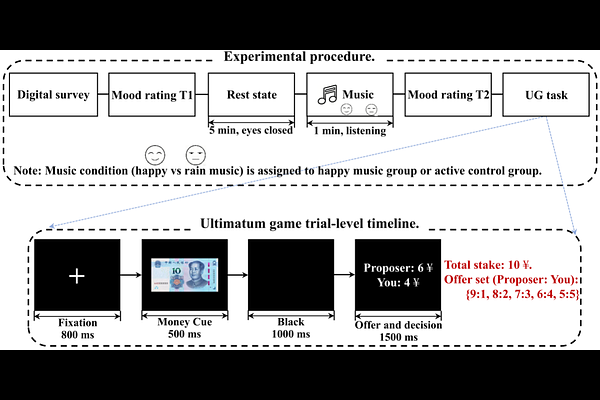
AbstractSocial decision making relies on dynamic affect cognition interactions across distributed brain networks, yet how incidental positive affect modulates these mechanisms at a millisecond timescale remains unclear. This study investigated the impact of music-induced positive emotion on the neural dynamics of decision-making in the Ultimatum Game. Fifty six participants were assigned to either a happy music group or an active control (rain sound) group. Fifty six participants were assigned to either a happy music group or an active control (rain sound) group, while electroencephalography was recorded to capture rapid neural dynamics. Behaviorally, happy music accelerated reaction times (RTs) and decoupled the ERP RT correlations observed in the control condition. Neurally, positive affect amplified event-related potential amplitudes during early conflict detection (220 to 280 ms) and late valuation (520 to 560 ms) stages. Multivariate pattern analysis further revealed that happy music enhanced the neural separability and temporal stability of decision states (accept vs. reject). Moreover, using support vector regression based on functional network features, we found that decision acceptance rates were predicted with significantly higher accuracy in the happy music group (R = 0.60) compared to controls (R = 0.41). Crucially, feature weight analysis indicated a topological shift in decision strategy: while the control group relied on frontal central edges (implicating executive control), the happy music group was characterized by central temporal connections (suggesting integrative processing). Collectively, these findings provide novel evidence that incidental emotion intervenes at the millisecond timescale to bias social choices, offering a dynamic network based account of the affect cognition interaction.