Structure-Activity Mapping of Intraperitoneal mRNA-LNPs: Decoupling Tumor and Liver Biodistribution in Pancreatic Cancer

Structure-Activity Mapping of Intraperitoneal mRNA-LNPs: Decoupling Tumor and Liver Biodistribution in Pancreatic Cancer
Islam, F.; Das, A.; Ashaduzzaman, M.; Ding, L.; Kumari, N.; Dai, R.; Oupicky, D.
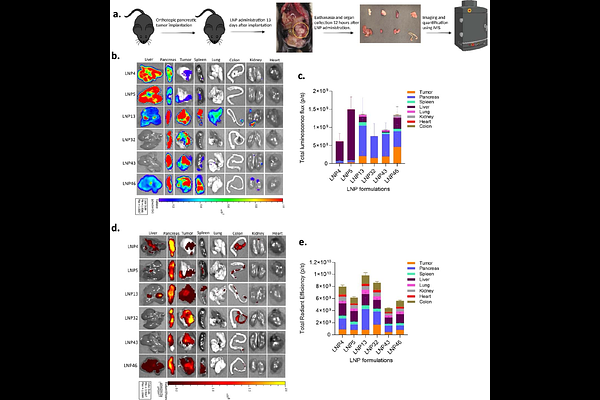
AbstractPancreatic cancer (PC) is a highly lethal disease with limited treatment options and poor prognosis. mRNA-based therapeutics offer potential by enabling targeted protein expression, but effective delivery to pancreatic tumors remains challenging. Lipid nanoparticles (LNPs) are a promising delivery system, protecting mRNA and aiding cellular uptake. This study developed and evaluated 48 mRNA-LNP formulations for intraperitoneal (IP) administration in pancreatic tumor models. Formulations, assembled via microfluidics, varied in lipid composition, incorporated RhB-DHPE for tracking, and encapsulated firefly Luciferase mRNA (fLuc mRNA) for expression analysis. Particle size, zeta potential, and toxicity were assessed. In vivo biodistribution and mRNA expression were studied in an orthotopic PC mouse model following IP administration. Results showed significant performance variation, with certain formulations preferentially accumulating in tumors, revealing links between biodistribution and expression. Statistical analysis (JMP software) identified critical formulation factors for delivery efficiency. This work highlights optimal formulation compositions for further development and informs rational LNP design for mRNA delivery in PC.