The ivory:mir-193 non-coding RNA gene controls melanic camouflage in a polymorphic moth

The ivory:mir-193 non-coding RNA gene controls melanic camouflage in a polymorphic moth
Livraghi, L.; Cassily, J. L.; Hanly, J. J.; Brayer, M.; Carter, A. T.; Alqassar, J. D.; Sim, S. B.; Geib, S. M.; Martin, A.
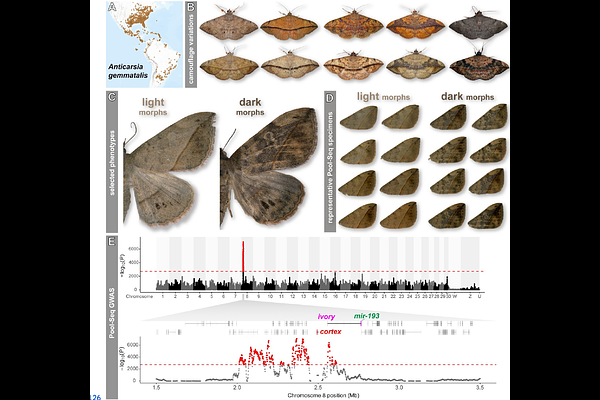
AbstractA majority of moths use melanic pigmentation to blend into the visual environment, and some species display genetically controlled color polymorphisms that provide tractable systems for dissecting the genetic basis of camouflage. Here we leveraged the natural polymorphism of Anticarsia gemmatalis moths to map a major-effect gene that controls melanic variation, and study its developmental roles using expression and loss-of-function assays. A genome-wide association mapping identifies the ivory:mir-193 non-coding RNA locus as a major locus of melanic variation, with highly-divergent haplotypes differentiating the Light and Dark morphs. Second, the expression of ivory:mir-193 prefigures the melanic coloration of each morph, and suggests that cis-regulatory variation at this locus determines the difference in adult pattern. Finally, CRISPR disruption of the ivory promoter and mir-193 hairpin region each abolish melanic scale pigmentation, demonstrating that this lnc-pri-miRNA module is required for dark-scale differentiation. These findings corroborate the emerging role of ivory:mir-193 as a key factor in the development of melanic patterning, and highlight its unique propensity to repeatedly drive phenotypic variation of adaptive potential in butterflies and moths.