Health-associated gut bacteriocins target TLR4 to suppress intestinal inflammation

Health-associated gut bacteriocins target TLR4 to suppress intestinal inflammation
SHI, Y.; Fang, X.; Lin, X.; Xie, X.; Chen, X.; Zhang, D.; Ma, x.; Chen, J.; Wei, X.; Ren, J.; Wu, G.; Zhou, C.; Chen, N.; Yang, G.; Liu, N.; Li, Y.-X.
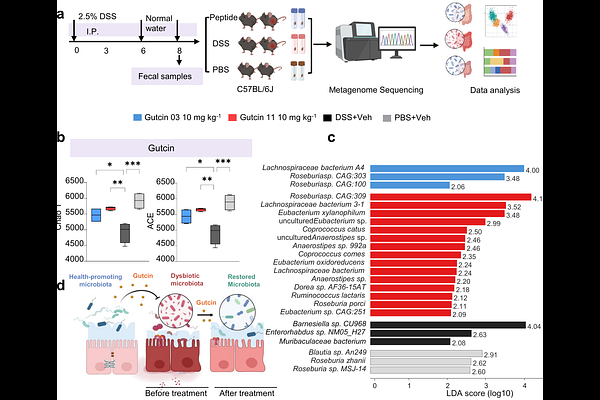
AbstractThe human microbiome maintains host immune homeostasis through the secretion of bioactive metabolites. However, the functions of most microbiome-encoded peptides remain poorly defined, extending beyond their well-characterized antimicrobial roles. In this study, we developed a multi-cohort metagenomic framework to profile protective class II bacteriocins, unmodified, ribosomally synthesized peptides, that are enriched in healthy individuals but depleted in patients with inflammatory bowel disease (IBD). We have designated these health-associated bacteriocins as gutcins. Two gutcins, which lack canonical antimicrobial activity, potently attenuate intestinal inflammation in murine models. Cryo-electron microscopy reveals that these peptides directly engage the C-terminus of TLR4, blocking its dimerization and downstream inflammatory signaling. Guided by this structural interface, we generated truncated variants with enhanced potency, demonstrating the amenability of these simple peptides to rational optimization. Collectively, our findings reposition class II bacteriocins from antimicrobial agents to endogenous immunomodulatory effectors and establish a structural and mechanistic foundation for their development as next-generation therapeutics for inflammatory intestinal disorders.