A rapid sporozoite viability assay identifies anti-Cryptosporidium parvum leads and targetable enzymatic activities in the invasive stage

A rapid sporozoite viability assay identifies anti-Cryptosporidium parvum leads and targetable enzymatic activities in the invasive stage
Jiang, P.; Wang, D.; Wang, Y.; Yin, J.; Zhu, G.
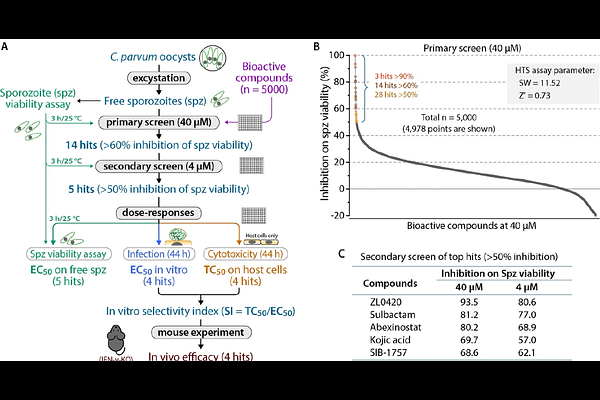
AbstractCurrent phenotypic screens for anti-Cryptosporidium compounds typically quantify intracellular parasite growth in host cell cultures after two days of infection. Here, we developed a rapid, host cell-free phenotypic assay that directly measures compound-induced loss of viability in excysted Cryptosporidium parvum sporozoites, the invasive stage that initiates infection. We first compared qRT-PCR, luminescence ATP, and resazurin fluorescence readouts for detecting viable sporozoites. The luminescence ATP assay provided the best balance of linear dynamic range, assay time, parasite input, and cost, and was therefore adapted for high-throughput screening. Screening 5,000 bioactive compounds at 40 M identified 28 primary hits with [≥]50% inhibition of sporozoite viability, including 14 with >60% inhibition. Secondary screening of these 14 compounds at 4 M identified five hits retaining >50% inhibition: ZL0420, sulbactam, abexinostat, kojic acid, and SIB-1757. All five showed submicromolar activity against free sporozoites, with EC50 values of 0.073-0.311 M. Four compounds, abexinostat, ZL0420, SIB-1757, and sulbactam, also inhibited intracellular parasite growth in vitro, with EC50 values of 0.316-11.87 M and selectivity indices from >17 to >107. In an IFN-{gamma}-knockout mouse model, these four compounds reduced oocyst shedding over the 35-day experiment by 53.7-79.0% based on area-under-the-curve analysis and improved body-weight trajectories and ileal histopathology. Biochemical assays further showed that abexinostat inhibited native parasite HDAC activity at low nanomolar concentrations, while sulbactam inhibited a {beta}-lactamase-like activity in sporozoite lysates. These findings establish sporozoite viability as a rapid screening endpoint and identify anti-Cryptosporidium leads associated with targetable enzymatic activities in the invasive stage.