Doxycycline inhibits both apicoplast and mitochondrial translation in apicomplexan parasites

Doxycycline inhibits both apicoplast and mitochondrial translation in apicomplexan parasites
Bulloch, M. S.; Crisafulli, E. M.; Hayward, J. A.; Ramesh, S.; Maclean, A. E.; Muellner-Wong, L.; Nie, S.; Stroud, D. A.; Sheiner, L.; Maier, A. G.; van Dooren, G. G.; Ralph, S. A.
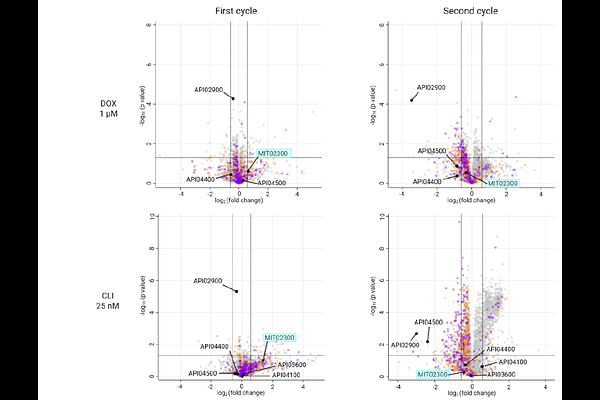
AbstractDoxycycline is a tetracycline-class antibiotic used for malarial prophylaxis and as an occasional partner drug in malaria treatment. Several lines of evidence suggest that doxycycline's antimalarial mechanism of action is through inhibiting the prokaryotic 70S ribosomes of the apicoplast, a non-photosynthetic plastid present in most apicomplexan species including Plasmodium and Toxoplasma. At lower concentrations (<5 M) doxycycline exhibits a delayed death phenotype, typical of inhibitors of apicoplast housekeeping processes. However, at higher concentrations (>10 M) doxycycline has rapid schizonticidal activity via an unknown and likely apicoplast-independent mechanism. In other eukaryotes, and plausibly in Plasmodium, doxycycline inhibits mitochondrial 70S ribosomes. Here we use a mass spectrometry approach to investigate organellar translation and its inhibition, and apply stable isotope-labelling with amino acids (SILAC) to assess steady state and turnover for proteins encoded by the apicoplast genome. We directly detected apicoplast encoded proteins by mass spectrometry and for the first time showed that these proteins decrease in both abundance and in synthesis following treatment with doxycycline and clindamycin. High concentrations of doxycycline, but not clindamycin, reduced the abundance of mitochondrial DNA encoded proteins required for the formation of complexes III and IV in the electron transport chain. Doxycycline treatment also disrupted oxidative phosphorylation in both P. falciparum and the related parasite Toxoplasma gondii, consistent with electron transport chain function being dependent on mitochondrial translation. Our data characterises the direct proteomic consequences of apicomplexan organellar translation inhibitors for the first time and reveals doxycycline as the first described mitochondrial translation inhibitor of P. falciparum and T. gondii.