Bacterial surface display enables lysis-independent joint host-pathogen single-cell profiling

Bacterial surface display enables lysis-independent joint host-pathogen single-cell profiling
Gunnarsson, C.; Hsiao, J. C.; Hochfelder, J. B.; Solomon, S. L.; Lepe, B. A.; Zhu, S.; Xu, K.; Chung, H.; Bryson, B. D.
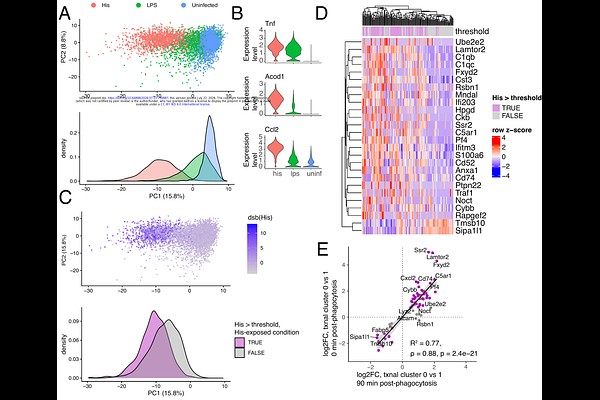
AbstractHeterogeneity in host-pathogen interactions arises from variation in both host cell state and pathogen state, yet most single-cell methods capture these features separately. Joint profiling is limited by fundamental technical mismatches between host- and pathogen-derived material, particularly differences in cell wall structure, lysis requirements, and molecular abundance. Here we introduce a lysis-independent strategy that enables unified measurement of intracellular bacterial presence and state alongside host single-cell profiles. We repurpose bacterial surface display to encode promoter activity and bacterial identity as antibody-detectable signals, rendering bacterial features compatible with existing antibody-based single-cell assays. This approach is modular across promoters, epitope tags, display scaffolds, and bacterial species, including Escherichia coli and Mycobacterium tuberculosis. Surface-displayed reporters are detectable during intracellular infection and can be read out by flow cytometry and droplet-based single-cell RNA sequencing without pathogen-specific lysis optimization or pre-sorting on pathogen signal. Applying this method to infected macrophages, we link heterogeneous bacterial uptake to heterogeneous expression of phagocytosis-associated host programs. This strategy enables scalable, joint host-pathogen single-cell measurements and expands the range of pathogens and states accessible to high-throughput single-cell analysis.