The Unstable Chromosphere: Effects of the Thermal Farley-Buneman Instability Across a Broad Range of Solar Chromospheric Conditions

The Unstable Chromosphere: Effects of the Thermal Farley-Buneman Instability Across a Broad Range of Solar Chromospheric Conditions
Samuel Evans, Meers Oppenheim, Juan Martínez-Sykora, Alexander Green
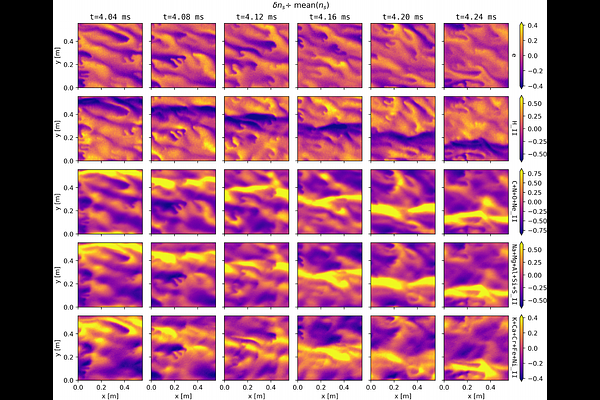
AbstractIn the coldest regions of the solar atmosphere, lingering discrepancies between models and observations may be caused by the Thermal Farley-Buneman Instability (TFBI). This meter-scale, electrostatic, collisional, multifluid plasma instability converts energy from neutral flows into turbulent motions and heating. In the neutral frame of reference, these neutral flows manifest as an electric field which can drive the TFBI. In this work, we simulate the TFBI across a broad range of solar chromospheric conditions. We find clear proportionality between between TFBI-driven relative temperature increases of charged species ($ΔT_{s}^{\text{(turb)}} / T_{s}^{(0)}$) and driving electric field strength relative to the theoretical threshold field required for TFBI growth. We also discover a correlation between relative driving field strength and turbulent motions. Additionally, the TFBI consistently causes average current density to rotate towards the driving field, with Pederson/ambipolar component ($\vec{J} \cdot \hat{E}^{(0)}$) increasing by up to roughly 60% while the Hall component ($\vec{J} \cdot \hat{E}^{(0)} \times \hat{B}$) decreases in magnitude by up to roughly 80%. Meanwhile, we find TFBI-driven turbulence increases neutral heating rates by $(43\pm7)\%$ on average, with 85% (28/33) of simulations having mean increase more than 29%, and a flat line of best fit suggesting zero correlation with driving field.