Self-Consistent Nonlinear Classical Cepheid Pulsations During Stellar Evolution with MESA

Self-Consistent Nonlinear Classical Cepheid Pulsations During Stellar Evolution with MESA
Ebraheem Farag, Earl P. Bellinger, Philip Mocz, Selim Kalici, R. Smolec, Shashi Kanbur, Kyra Bettwy, Christopher Lindsay
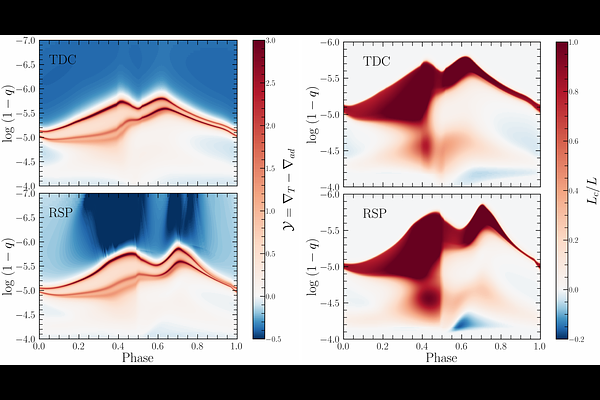
AbstractWe extend the time-dependent convection treatment in \code{MESA} by introducing eddy-viscous damping. This software change brings \code{MESA-TDC} into closer alignment with the radial stellar pulsation framework of \code{MESA-RSP}. We demonstrate that the inclusion of the eddy viscosity in hydrodynamic stellar models remains stable on evolutionary timescales. We then present the first self-consistent integration of large-amplitude, nonlinear Classical Cepheid pulsations directly within a \code{MESA-star} evolutionary run, demonstrating that the time-dependent convection formalism implemented in \code{MESA-star} and the \code{MESA} radial stellar pulsation (RSP) module are physically identical. Starting from a 6~\Msun\ blue-loop stellar evolution model, we demonstrate evolving the entire stellar model through pulsations as well as pausing the evolution, excising the core, and remeshing the envelope to match the grid used by \code{MESA-RSP}. We compare the pulsation properties (e.g., period, light and radius curves, and growth rate) with a matched \code{MESA-RSP} run, and find reasonable agreement between the two modules. This unified approach eliminates the reliance on separate post-processing workflows and enables fully coupled evolution-pulsation simulations. This approach enables future studies of stellar pulsations with the inclusion of composition gradients, mass loss, or rotation. It also enables future studies of the $ε$ mechanism as well as providing a physical source of viscosity for other science cases explored using \code{MESA}'s hydrodynamics solver. We have integrated these modifications into the \code{MESA-star} module, enabling open-source use by the community.