Probing the Atmospheres of Young Long-Period Sub-Neptune Progenitors with ELT/ANDES

Probing the Atmospheres of Young Long-Period Sub-Neptune Progenitors with ELT/ANDES
Spandan Dash, Dwaipayan Dubey, Liton Majumdar
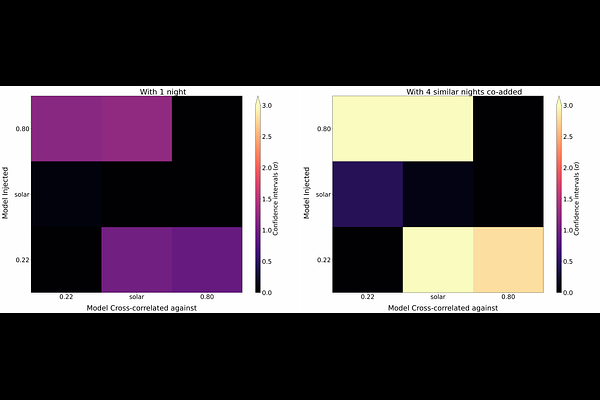
AbstractHigh-resolution cross-correlation spectroscopy (HRCCS) has emerged as a powerful technique for detecting and characterizing exoplanet atmospheres from the ground. While it has been highly successful for ultra-hot Jupiters and hot Jupiters, next-generation facilities such as ELT/ANDES will extend its reach to smaller and longer-period planets, including young sub-Neptunes and their progenitors. We investigate whether HRCCS with ELT/ANDES can robustly recover orbital parameters and atmospheric signals of the long-period sub-Neptunes V1298Taub and TOI-451c. For such systems, the slow Doppler drift of the planetary signal over a single night reduces its separation from stationary telluric contamination, increasing the risk of signal removal while detrending. We therefore quantify the impact of including out-of-transit exposures on signal recovery and parameter estimation. We simulate transmission observations in the YJH bands using the Ratri pipeline and analyze them with the HRCCS framework Upamana. For V1298Taub, we inject atmospheric signals consistent with HST, Spitzer, and JWST constraints. For TOI-451c, we explore models spanning sub-solar to super-solar C/O ratios to assess compositional sensitivity. We find that incorporating out-of-transit exposures significantly enhances detectability, provided that the detrending effects are consistently propagated to the template models prior to cross-correlation. Without this reprocessing step, recovered orbital parameters can deviate substantially from injected values or yield reduced detection significance. For V1298Tau b, >5$σ$ detections of H2O, H2S, and CO are achievable within $\lesssim$10 hours (~2 nights). For TOI-451c, distinguishing sub-solar from super-solar C/O ratios requires $\geq$18 hours. HRCCS with ELT/ANDES will therefore be a key tool for probing the atmospheric diversity of young, long-period sub-Neptunes in the ELT era.