Determinants of chromosomal rearrangements in holocentric Leptidea butterflies

Determinants of chromosomal rearrangements in holocentric Leptidea butterflies
Thörn, F.; Claret-Imbert, J.-L.; Backström, N.; Boman, J.
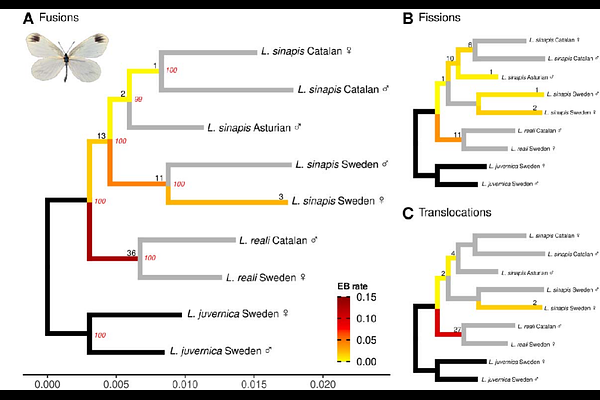
AbstractChromosomes can undergo large-scale rearrangements such as fissions and fusions. Occasional rearrangements can be common, especially in organisms with holocentric chromosomes such as butterflies. However, high rates of fissions and fusions have only been observed in a few taxonomic groups. One such group is the Palearctic Leptidea butterflies, where fissions and fusions have resulted in considerable inter- and intraspecific variation in chromosome numbers. The large number of chromosome rearrangements in Leptidea , provides a rare opportunity to study the mutational determinants of chromosome rearrangements within a statistical framework. Using nine chromosome-level genome assemblies and 138 whole-genome re-sequenced individuals, we mapped evolutionary breakpoint regions and quantified the association between annotation features and rearrangements. Evolutionary breakpoint regions were significantly depleted in protein-coding genes and the majority resided in repetitive regions. However, rearrangements were only weakly associated with transposable elements. Instead, the strongest sequence predictors were large clusters of satellite DNA, ribosomal DNA and segmental duplications, with differing patterns among rearrangement types. Copy-number variation was observed in evolutionary breakpoint regions and lineages dominated by fissions or fusions were associated respectively with genome-expansion and -reduction. The results give novel insights into the mechanistic basis of interchromosomal rearrangements.