Size limits on tidal debris around white dwarfs: the km-size barrier

Size limits on tidal debris around white dwarfs: the km-size barrier
Jordan K. Steckloff, Dimitri Veras, Kathryn Volk
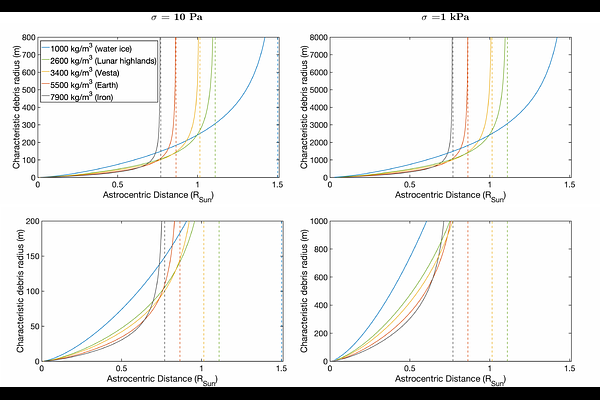
AbstractCompact disks of planetary debris orbiting white dwarfs provide a crucial window into our understanding of evolved planetary systems. The formation of these disks has been widely modeled with tidal fragmentation of minor planets that are rubble piles with no internal strength. However, rubble piles do have non-zero cohesive strength from Van der Waals forces, and here we demonstrate the consequences: breakup of these rubble piles sets a maximum fragment size, and we calculate this size \jks{for water ice, iron, and material densities corresponding to the lunar highlands, Vesta and the Earth}. We find that for typical minimum rubble pile strengths of $\sim$10-1000 Pa, the maximum fragment size is as large as small asteroids (0.1-1 km). This limit -- the km-size barrier -- also represents the characteristic sizes of tidal fragments. Most of the debris mass is contained in fragments of this size. Consequently, subsequent disk evolution should first feature a prominent dust-forming process, such as collisional grinding, before Poynting-Robertson drag can significantly shape the final disk. \jks{Further, we find that non-zero internal strength more narrowly radially confines the fragments than in the strengthless case.} This correction to previous assumptions adds to the growing evidence of the importance of collisions in the formation and evolution of white dwarf debris disks, while also helping to bound the size distribution in these disks for modeling efforts.