Science-Driven Performance Requirements for UV Coronagraph Design: Implications for O$_3$ Detection in Earth-like Atmospheres

Science-Driven Performance Requirements for UV Coronagraph Design: Implications for O$_3$ Detection in Earth-like Atmospheres
Amber V. Young, Giada Arney, Shawn Domagal-Goldman, Tyler D. Robinson, Roser Juanola-Parramon, Christopher Stark, Renyu Hu, Armen Tokadjian, Mario Damiano
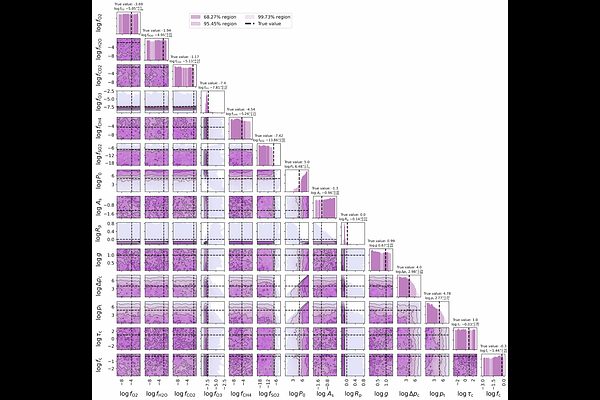
AbstractDetecting biosignatures on Earth-like exoplanets from the Proterozoic era requires instrumentation capable of probing near-ultraviolet (NUV) spectral features, particularly ozone (\ce{O3}), which serves as an indirect proxy for molecular oxygen (\ce{O2}) when direct detection is challenging. Using a combination of photochemical-climate modeling and atmospheric retrieval simulations, we quantify fiducial instrument performance requirements for robust \ce{O3} detection and assess the risk of spectral false positives from sulfur dioxide (\ce{SO2}). Our analysis demonstrates the \ce{O3} abundances for Proterozoic Earth-like planets with \ce{O2} as low as 0.1\% the present atmospheric level, can be constrained to within an order of magnitude at 1\,$σ$ confidence using three adjacent photometric bandpasses at a signal-to-noise ratio of 10 at 0.366\,$\upmu$m, each with a 15\% width, and a short wavelength cutoff for those observations near 0.26\,$\upmu$m. The self-consistent steady state atmospheric modeling results show that \ce{SO2} buildup is difficult in a habitable environment with appreciable amounts of water vapor in its atmosphere and would require volcanic outgassing rates at least two orders of magnitude above present-day Earth to reach surface abundance levels comparable to Proterozoic Earth-like abundances of \ce{O3}. Even under these high \ce{SO2} flux scenarios, \ce{SO2} remains largely unconstrained with the recommended observational configuration, reinforcing the need for NUV coverage in coronagraphic instruments. Our findings support the inclusion of UV-optimized optics and detectors on the Habitable Worlds Observatory (HWO) to enable biosignature detection strategies sensitive to atmospheric conditions across key phases of Earth's geological history.