Euclid. Properties and performance of the NISP signal estimator

Euclid. Properties and performance of the NISP signal estimator
Euclid Collaboration, F. Cogato, B. Kubik, R. Barbier, S. Conseil, E. Medinaceli, Y. Copin, E. Franceschi, L. Valenziano, N. Aghanim, B. Altieri, S. Andreon, N. Auricchio, C. Baccigalupi, M. Baldi, A. Balestra, S. Bardelli, P. Battaglia, A. Biviano, E. Branchini, M. Brescia, J. Brinchmann, S. Camera, G. Cañas-Herrera, V. Capobianco, C. Carbone, J. Carretero, S. Casas, M. Castellano, G. Castignani, S. Cavuoti, A. Cimatti, C. Colodro-Conde, G. Congedo, C. J. Conselice, L. Conversi, L. Corcione, A. Costille, F. Courbin, H. M. Courtois, R. da Silva, H. Degaudenzi, G. De Lucia, H. Dole, F. Dubath, X. Dupac, S. Dusini, A. Ealet, S. Escoffier, M. Farina, R. Farinelli, F. Faustini, S. Ferriol, F. Finelli, N. Fourmanoit, M. Frailis, M. Fumana, S. Galeotta, K. George, W. Gillard, B. Gillis, C. Giocoli, J. Gracia-Carpio, A. Grazian, F. Grupp, S. V. H. Haugan, W. Holmes, F. Hormuth, A. Hornstrup, P. Hudelot, K. Jahnke, M. Jhabvala, E. Keihänen, S. Kermiche, A. Kiessling, R. Kohley, M. Kümmel, M. Kunz, H. Kurki-Suonio, A. M. C. Le Brun, S. Ligori, P. B. Lilje, V. Lindholm, I. Lloro, G. Mainetti, D. Maino, E. Maiorano, O. Mansutti, S. Marcin, O. Marggraf, M. Martinelli, N. Martinet, F. Marulli, R. J. Massey, S. Mei, Y. Mellier, M. Meneghetti, E. Merlin, G. Meylan, A. Mora, M. Moresco, L. Moscardini, C. Neissner, S. -M. Niemi, C. Padilla, S. Paltani, F. Pasian, K. Pedersen, W. J. Percival, V. Pettorino, S. Pires, G. Polenta, M. Poncet, L. A. Popa, F. Raison, A. Renzi, J. Rhodes, G. Riccio, E. Romelli, M. Roncarelli, C. Rosset, E. Rossetti, R. Saglia, Z. Sakr, A. G. Sánchez, D. Sapone, B. Sartoris, M. Schirmer, P. Schneider, M. Scodeggio, A. Secroun, G. Seidel, S. Serrano, P. Simon, C. Sirignano, G. Sirri, L. Stanco, J. Steinwagner, P. Tallada-Crespí, D. Tavagnacco, A. N. Taylor, I. Tereno, S. Toft, R. Toledo-Moreo, F. Torradeflot, I. Tutusaus, J. Valiviita, T. Vassallo, A. Veropalumbo, Y. Wang, J. Weller, A. Zacchei, F. M. Zerbi, E. Zucca, M. Ballardini, M. Bolzonella, E. Bozzo, C. Burigana, R. Cabanac, M. Calabrese, A. Cappi, T. Castro, J. A. Escartin Vigo, G. Fabbian, L. Gabarra, J. García-Bellido, V. Gautard, S. Hemmati, J. Macias-Perez, R. Maoli, J. Martín-Fleitas, N. Mauri, R. B. Metcalf, P. Monaco, A. Pezzotta, M. Pöntinen, I. Risso, V. Scottez, M. Sereno, M. Tenti, M. Tucci, M. Viel, M. Wiesmann, Y. Akrami, G. Alguero, I. T. Andika, G. Angora, S. Anselmi, M. Archidiacono, F. Atrio-Barandela, L. Bazzanini, D. Bertacca, M. Bethermin, F. Beutler, A. Blanchard, L. Blot, M. Bonici, S. Borgani, M. L. Brown, S. Bruton, A. Calabro, B. Camacho Quevedo, F. Caro, C. S. Carvalho, Y. Charles, A. R. Cooray, O. Cucciati, S. Davini, F. De Paolis, G. Desprez, A. Díaz-Sánchez, S. Di Domizio, J. M. Diego, V. Duret, M. Y. Elkhashab, A. Enia, Y. Fang, A. G. Ferrari, A. Finoguenov, A. Fontana, A. Franco, K. Ganga, T. Gasparetto, E. Gaztanaga, F. Giacomini, F. Gianotti, G. Gozaliasl, A. Gruppuso, M. Guidi, C. M. Gutierrez, A. Hall, H. Hildebrandt, J. Hjorth, J. J. E. Kajava, Y. Kang, V. Kansal, D. Karagiannis, K. Kiiveri, J. Kim, C. C. Kirkpatrick, S. Kruk, M. Lattanzi, L. Legrand, F. Lepori, G. Leroy, G. F. Lesci, J. Lesgourgues, T. I. Liaudat, M. Magliocchetti, A. Manjón-García, F. Mannucci, C. J. A. P. Martins, L. Maurin, M. Miluzio, A. Montoro, C. Moretti, G. Morgante, S. Nadathur, K. Naidoo, P. Natoli, A. Navarro-Alsina, S. Nesseris, L. Pagano, E. Palazzi, D. Paoletti, F. Passalacqua, K. Paterson, L. Patrizii, A. Pisani, D. Potter, G. W. Pratt, S. Quai, M. Radovich, W. Roster, S. Sacquegna, M. Sahlén, D. B. Sanders, E. Sarpa, A. Schneider, D. Sciotti, E. Sellentin, L. C. Smith, K. Tanidis, F. Tarsitano, G. Testera, R. Teyssier, S. Tosi, A. Troja, A. Venhola, D. Vergani, G. Verza, P. Vielzeuf, S. Vinciguerra, N. A. Walton, A. H. Wright
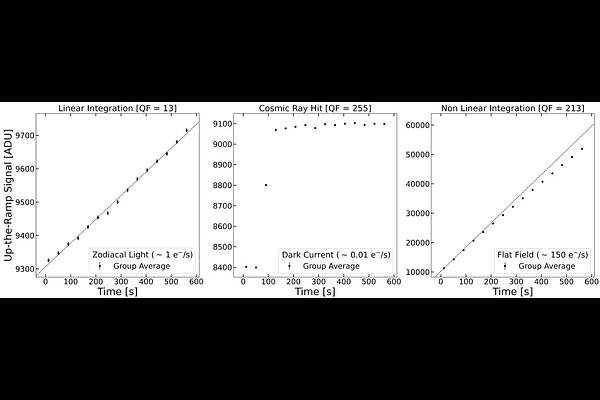
AbstractThe Euclid spacecraft, located at the second Lagrangian point of the Sun-Earth system, hosts the Near-Infrared Spectrometer and Photometer (NISP) instrument. NISP is equipped with a mosaic of 16 HgCdTe-based detectors to acquire near-infrared photometric and spectroscopic data. To meet the spacecraft's constraints on computational resources and telemetry bandwidth, the near-infrared signal is processed onboard via a dedicated hardware-software architecture designed to fulfil the stringent Euclid's data-quality requirements. A custom application software, running on the two NISP data processing units, implements the NISP signal estimator: an ad-hoc algorithm which delivers accurate flux measurements and simultaneously estimates the quality of signal estimation through the quality factor parameter. This paper investigates the properties of the NISP signal estimator by evaluating its performance during the early flight operations of the NISP instrument. First, we revisit the assumptions on which the inference of the near-infrared signal is based and investigate the origin of the main systematics of the signal estimator through Monte Carlo simulations. Then, we test the flight performance of the NISP signal estimator. Results indicate a systematic bias lower than 0.01 e/s for 99% of the NISP pixel array, well within the noise budget of the estimated signal. We also derive an analytical expression for the variance of the NISP signal estimator, demonstrating its validity, particularly when the covariance matrix is not pre-computed. Finally, we provide a robust statistical framework to interpret the QF parameter, analyse its dependence on the signal estimator bias, and show its sensitivity to cosmic ray hits on NISP detectors. Our findings corroborate previous results on the NISP signal estimator and suggest a leading-order correction based on the agreement between flight data and simulations.