The non-equilibrium state of the Galactic disk $-$ new insights from GALAH DR4

The non-equilibrium state of the Galactic disk $-$ new insights from GALAH DR4
Peng Yang, Hai-Feng Wang, Joss Bland-Hawthorn, Guo-Jun Cheng, Yu-Zheng Wang, Yang-Ping Luo, Kun Wang
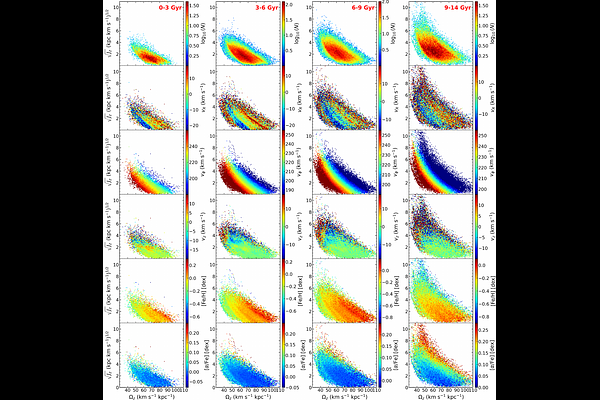
AbstractThe non-equilibrium state of the Galactic disk has drawn extensive attention since ESA's \textit{Gaia} launch. Complex structure appears across a multi-parameter space of stellar abundances, ages, and kinematics. Using GALAH DR4, we investigate ridge and phase-spiral structures in chemical-abundance, phase ($v_i,x_i$), action--angle ($J_i,θ_i$), and frequency--action ($Ω_i,J_i$) spaces ($i=R,φ,z$). Our sample includes 333,412 disk stars with reliable chemodynamical data. In the $R$--$v_φ$ plane, ridges trace near-constant $J_φ$ tracks and show coherent variations in $θ_R$ and $θ_φ$. In $J_φ$--$J_R$, ridges are most prominent when encoded by $z_{\rm max}$ and preferentially associate with metal-rich, low-$α$ populations. In the solar neighbourhood ($R=7.2$--$9.2$\,kpc), we recover a clear phase spiral in $z$--$v_z$. Encoded in $v_φ$, $Ω_R$, or $Ω_φ$, one-armed spirals appear, whereas the $v_R$-encoded map shows a two-armed spiral. Projecting actions onto $z$--$v_z$ reveals residual spiral signatures in $J_R$ and $J_φ$, indicating that the phase spiral encodes in-plane orbital information. Both structures depend on age: ridges remain at similar locations with varying contrast, while the phase spiral is more tightly wound in younger and more loosely wound in older populations. Several ridges correspond in $J_φ$ to known moving groups, and excluding stars in all six moving-group regions makes the phase spiral less distinct in mean radial velocity maps. These links support interpreting ridges, phase spirals, and moving groups within a common phase-space dynamical framework. Combined with trends in orbital properties, age, and abundance, these findings suggest a common dynamical origin and distinct chemodynamical responses of a perturbed Galactic disk.