Distinct genetic architecture of gene and isoform level QTL in the Diversity Outbred (DO) mouse population

Distinct genetic architecture of gene and isoform level QTL in the Diversity Outbred (DO) mouse population
Opara, C. I.; Mitok, K. A.; Emfinger, C. H.; Schueler, K. L.; Stapleton, D. S.; Benkusky, N. A.; Gardiparthi, U.; Willis, K. H.; Ruotti, V.; Yandell, B. S.; Churchill, G. A.; Keller, M. P.; Attie, A. D.
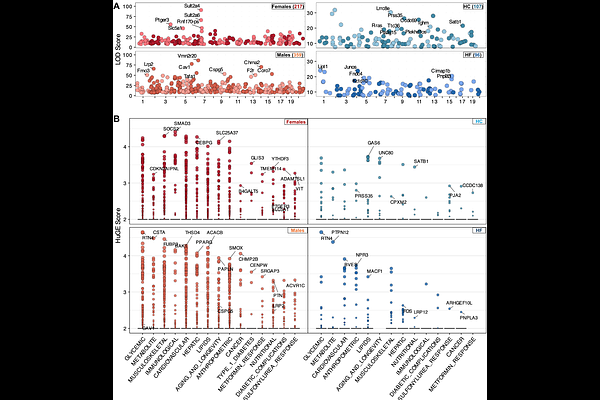
AbstractGenetic association studies of mRNA abundance phenotypes link regulatory gene loci to mRNA abundance (quantitative trait loci; QTL). The majority of eQTL studies are limited to gene-level mRNAs and have not focused on mRNA isoforms. Here, we utilized a large, genetically diverse mouse population to map QTL for both gene and transcript isoform abundance. Gene and isoform-level QTL mapping recovered largely overlapping sets of locally regulated mRNAs, which contrasted with the predominantly non-overlapping distally regulated mRNAs, particularly those influenced by sex and diet. Using allele-effect patterns from local QTL for protein-coding gene-isoform pairs, we show that genetic variation drives allele-specific isoform usage, generating isoforms whose genetic signals diverge from their aggregated gene-level effects through predominantly post-transcriptional mechanisms. We conducted pathway enrichment on distal mRNA hotspots and uncovered isoform-level pathways not detected with gene-level traits. We then applied a composite mediation approach at distal hotspots that compares gene-gene, isoform-isoform, and isoform-gene mediator models. By contrasting these causal models of transcriptional regulation, we identified unique associations between mRNA isoforms, undetected at the gene level. We also characterized the influence of sex and diet on mRNA expression in this study. Our data also suggest that sex and diet influence expression primarily through distal-acting genetic loci. We integrated our QTL data with human genetic data, prioritizing effector genes in loci associated with metabolically relevant traits that suggest conditional dependence on sex and diet in humans. Overall, our findings highlight distinctive mechanisms of transcriptional regulation and emphasize the need to prioritize an isoform-level focus for genetic association studies to avoid missed signals that may arise from the gene-level only QTL mapping.