Foreground Characterization and Mitigation in the Observations of the CD/EoR with the SKA

Foreground Characterization and Mitigation in the Observations of the CD/EoR with the SKA
Jacob Burba, Philip Bull, Emilio Ceccotti, Arnab Chakraborty, Samir Choudhuri, Abhirup Datta, Khandakar Md Asif Elahi, Sambit K. Giri, Vibor Jelic, Yi Mao, Florent Mertens, Satyapan Munshi, Ridhima Nunhokee, Andre R. Offringa, Samit Kumar Pal, Rashmi Sagar, Peter H. Sims, Huanyuan Shan, Takumi Ito, Anshuman Tripathi, Emma Tolley, Le Zhang, Zhenghao Zhu
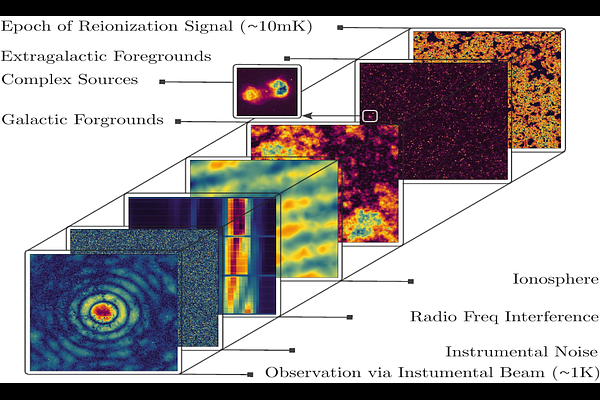
AbstractThe Square Kilometre Array (SKA), with its unprecedented sensitivity, frequency coverage, and large collecting area, is poised to revolutionize our understanding of the Cosmic Dawn (CD) and Epoch of Reionization (EoR) epochs marking the formation of the first luminous sources and the subsequent reionization of the intergalactic medium (IGM). However, detecting the faint redshifted 21-cm signal from neutral hydrogen remains one of the foremost challenges in observational cosmology, as it is buried beneath bright foregrounds from Galactic synchrotron radiation, free-free emission, and extragalactic point sources that are 4-5 orders of magnitude stronger than the cosmological signal. In this chapter, we highlight the key components and characteristics of these foregrounds and review ongoing efforts to model, characterize, and mitigate them. We emphasize how the SKA-Low AA* configuration, through its optimized array design, wide field of view, and improved calibration accuracy, enhances our capacity to suppress foreground contamination and recover the cosmological signal. The SKA Observatory Foreground Challenge plays a pivotal role in this effort by bringing together the global EoR/CD community to develop, compare, and validate foreground removal pipelines using realistic simulated datasets. Building on the experience of existing pathfinders such as LOFAR, MWA, and HERA, these collaborative initiatives are helping refine statistical and machine learning-based approaches for signal recovery. Together, these advancements are laying the groundwork for the SKA to probe the thermal and ionization history of the early Universe with unprecedented precision.