Cycles of contamination and recovery: Combined sewer overflows drive acute but transient antimicrobial resistance exposure in an urban stream

Cycles of contamination and recovery: Combined sewer overflows drive acute but transient antimicrobial resistance exposure in an urban stream
Konyali, D.; Mayer, R. P.; Schubert, S.; Kneis, D.; Benisch, J.; Teran-Velasquez, G.; Erdem, E. D.; Tskhay, F.; Oertel, R.; Krebs, P.; Berendonk, T. U.; Klümper, U.
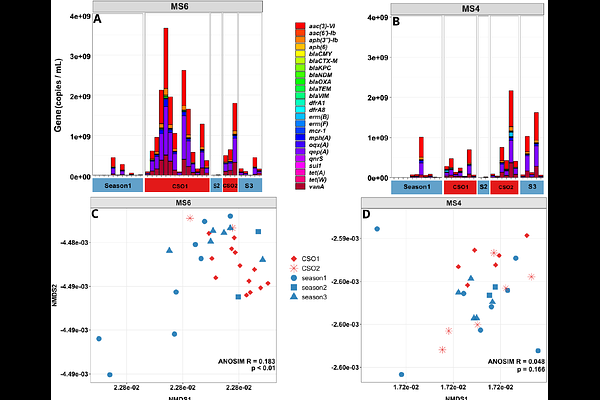
AbstractCombined sewer overflows (CSOs) are a major pathway for untreated wastewater into urban streams, yet their role in shaping antimicrobial resistance (AMR) dynamics remains poorly understood. Here, we used high-frequency, time-resolved sampling during two storm-triggered CSO events across two monitoring locations and one stormwater-only control site in an urban stream to quantify how these disturbances affect microbial communities, antibiotic resistance genes (ARGs), and mobile genetic elements (MGEs) in an urban stream. CSO events caused rapid, up to two orders of magnitude, increases in bacterial, pathogen, and ARG abundance, with multiple transient peaks occurring within single overflow episodes. However, these increases were largely proportional to the total bacterial load, and most ARGs and MGEs did not change in relative abundance, indicating that CSOs primarily act as mass-transfer events rather than drivers of in situ selection. Downstream attenuation was governed by hydrological dilution despite additional CSO inputs: Both microbial and resistance signals largely returned to baseline within short time frames. This demonstrates that CSOs function as hydrologically driven pulse disturbances that generate acute but transient AMR exposure. Because CSO events lack the sustained pressure associated with continuous wastewater discharges, rapid washout prevents the long-term establishment of sewage-derived resistance. These findings highlight that AMR risk in CSO-impacted systems is driven primarily by short-term exposure rather than by persistent ecological transformation, with important implications for urban water management under increasingly extreme rainfall conditions.