Mapping Oscillatory Flows in a Giant Chromospheric Spiral

Mapping Oscillatory Flows in a Giant Chromospheric Spiral
Yash. B. Saneshwar, Eamon Scullion, Gert J. J. Botha
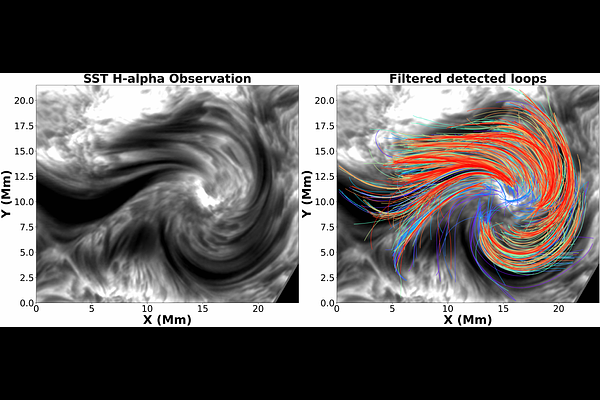
AbstractThe solar chromosphere is permeated by complex magnetic fields that guide plasma flows and energy into the corona. This work presents a detailed analysis of a unique, high-resolution observation of a giant chromospheric spiral structure that emerges due to a large magnetic pore, captured by the Swedish 1-m Solar Telescope (SST). A comprehensive data analysis pipeline is developed to automatically detect the edges of 2255 plasma flows (loops) that constitute the spiral, and these are used to extract the kinematics of flows propagating along the magnetic field. The analysis reveals three primary insights into the spiral's physics. First, magnetic curvature is correlated with oscillatory flow dynamics, i.e. regions of high loop curvature exhibit a statistically significant excess of higher-order oscillation modes compared to straighter loops; it is also correlated with higher intensity and longer periods. Second, spatial distribution of oscillation period shows an inverse trend, decreasing from $\sim$3.5 minutes in the pore to $\sim$3 minutes in the outer spiral arms. This is interpreted as a signature of the overlying trans-equatorial quadrupolar coronal loop system compressing the pore's field lines into a near-horizontal orientation, producing a period gradient that challenges the standard expanding canopy model. Finally, the emission signature confirms that oscillating threads represent localised channels of brightness that lie within cooler, absorbing loop material. This study provides the first statistical analysis of oscillatory flows in a large-scale spiral, probing energy flow through the chromosphere through curved magnetic structure.