Temporal Structure of Reward Availability and Sensory Uncertainty Modulate Allocation Dynamics in Naturalistic Foraging

Temporal Structure of Reward Availability and Sensory Uncertainty Modulate Allocation Dynamics in Naturalistic Foraging
Alefantis, P.; Guo, Y.; Quazi, N.; Savin, C.; Angelaki, D. E.; Pitkow, X.; Majaj, N. J.
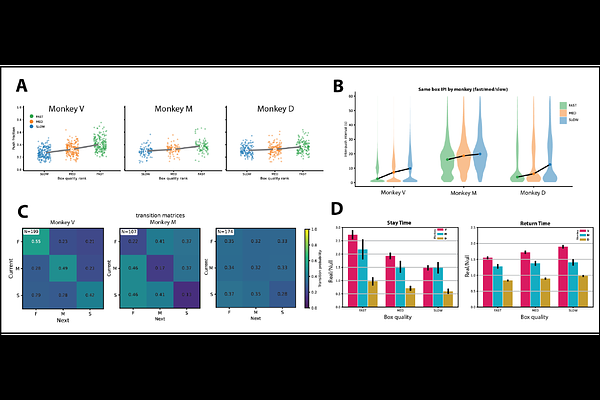
AbstractAdaptive foraging requires animals to combine uncertain sensory cues with predictions about when rewards are likely to occur. While theoretical models describe how animals should allocate their effort under variable-interval reward schedules, it remains unclear how the timing or rewards and the reliability of sensory cues affects behavior. We developed a continuous foraging task in which freely moving macaque monkeys navigated among three reward patches. Rewards became available at unpredictable times, with their availability signaled by a visual cue of varying reliability. We also varied the schedule of reward availability: in some conditions, rewards were equally likely to become available at any moment (exponentially distributed intervals), while in others the interval distribution was more concentrated around a particular mean (gamma-distributed intervals) which increased the cost of premature responses. Under exponential schedules, monkeys eventually allocated their time at different patches according to reward schedules, and cue reliability had only modest effects. Under gamma-distributed intervals, monkeys more quickly learned to differentiate between patches. Their choices were more strongly dependent on predicted reward timing, particularly when sensory cues were highly reliable. These results show that both the timing of rewards and reliability of sensory cues shape how animals allocate their time and effort in continuous naturalistic foraging tasks.