Mitigating consecutive drought impacts on forest productivity through strategic tree species spatial design

Mitigating consecutive drought impacts on forest productivity through strategic tree species spatial design
Yu, W.; Brose, U.; Gauzens, B.
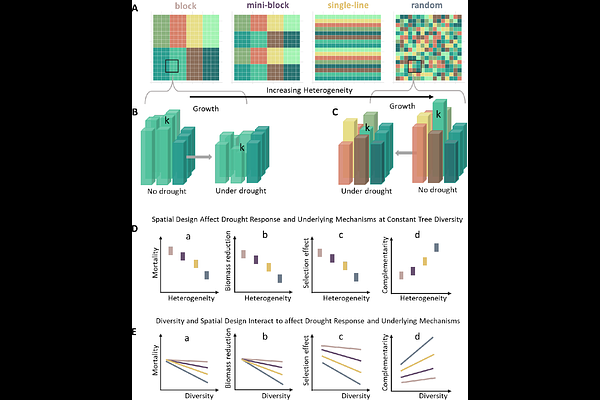
AbstractThe rising frequency and severity of multiyear droughts due to climate change poses a serious threat to tree growth and survival, compromising our terrestrial carbon sink. Although tree diversity is known to enhance forest biomass production, its role in mediating drought impacts remains elusive due to inconsistent evidence and limited understanding of species interactions. Using empirically parameterized pairwise interactions among eight tree species, we show that tree diversity buffers forest communities against repeated drought-induced biomass loss. This buffering arises from heterogeneous neighborhoods that promote both niche differentiation and facilitative interactions among species. We further demonstrate that strategic planting designs, such as random or single-line spatial arrangements, amplify these benefits by maximizing neighborhood heterogeneity, with single-line being more plausible when balancing management effort. Our simulation results suggest that increasing diversity could raise carbon sequestration rates by 18.8%. These findings corroborate tree diversity and spatial heterogeneity as actionable, climate-adaptive tools that simultaneously enhance forest productivity, drought resilience, and long-term carbon sequestration.