Encoding and Retrieval in Parallel: ERP Correlates of Continuous Recognition Memory for Natural Scenes

Encoding and Retrieval in Parallel: ERP Correlates of Continuous Recognition Memory for Natural Scenes
Busch, N. A.; Cesnaite, E.
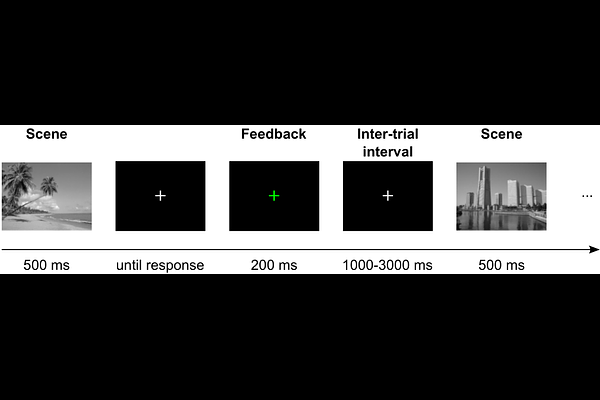
AbstractHuman long-term memory for visual scenes is remarkably robust, yet the neural mechanisms supporting memory encoding and retrieval remain poorly understood when both processes must operate at the same time. For instance, this might happen when we encounter a familiar place while simultaneously forming new memories of this encounter. We investigated electrophysiological correlates of visual recognition memory using a continuous recognition task (CRT), in which participants judged a continuous stream of scene photographs as previously seen or new, such that encoding and retrieval occurred in parallel on every trial. To make recognition particularly demanding, stimuli were drawn from only four scene categories. Thirty-one participants performed the task while EEG was recorded, and we analyzed canonical ERP markers of retrieval (mid-frontal FN400, 300-550 ms; late parietal effect, LPE, 550-800 ms) and encoding (subsequent memory effect, SME) as a function of stimulus repetition and lag between consecutive presentations. FN400 showed robust old/new effects for both repetitions, whereas LPE differences emerged only at the second repetition. While FN400 amplitude was insensitive to lag, LPE amplitude decreased systematically with increasing lag, mirroring the behavioral pattern of declining accuracy and slower responses. A significant SME emerged selectively for images subsequently recognized on both repetitions, indicating that the SME in continuous recognition is specific for the most robustly encoded items and reflects the strength of encoding. Together, these findings show that canonical ERP markers of recognition memory are preserved even when encoding and retrieval operate concurrently, but their expression depends on how often and how recently an item has previously been encoded -- parameters that can be flexibly manipulated within the CRT. This demonstrates that the CRT is sensitive to fine-grained temporal dynamics of memory formation and retrieval that could be missed under standard single-repetition designs.