Complementary multiphoton tools to create 3D architectures in soft hydrogels for epithelial tissue engineering.

Complementary multiphoton tools to create 3D architectures in soft hydrogels for epithelial tissue engineering.
Moser, S.; Hasenauer, A.; Shen, X.; Ramakrishna, S. N.; Isa, L.; Style, R.; Zenobi-Wong, M.
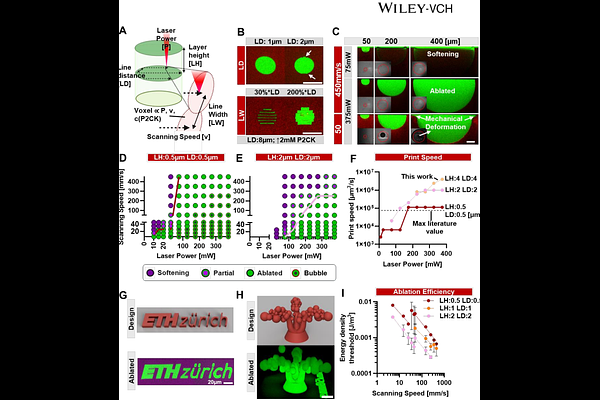
AbstractCurvature provides essential mechanical cues for epithelial cells, playing a key role in cell differentiation and morphology. Repeatable manufacture of precisely controlled curvature in soft hydrogel materials is therefore essential to study epithelial mechanobiology and function. Multiphoton (MP) based biofabrication holds promise due to its high resolution and three-dimensional design flexibility. Here, we leverage MP's advantages while increasing print speed to develop two complementary tools based on replica molding and multiphoton ablation. These can provide scalable hydrogel curvatures with tunable surface properties relevant for epithelial tissue engineering. In replica molding, MP prints are transferred into PDMS used to pattern centimeter scale arrays in hydrogels. In multiphoton ablation, hydrogels are locally degraded to generate precisely controlled curvatures and surface topography. With both methods, we repeatably guide epithelial cells into alveolar and duct-like shapes. Concave alveolar-like surfaces are shown to enhance the formation of thicker epithelial layers. We observe that surface properties, controlled by both tools, could enhance cytoskeletal organization. Using these biofabrication techniques, individual effects of curvature, surface properties, hydrogel composition, and bulk stiffness on epithelial cells can be studied. Both approaches offer high curvature control and throughput, providing a viable alternative to traditional 3D culture and other printing methods.