Feasibility of up-the-ramp sampling under variable sky for ground-based spectrographs

Feasibility of up-the-ramp sampling under variable sky for ground-based spectrographs
Gaia Gaspar, Marcin Sawicki, Nelson Nunes, Rubén J. Díaz, James E. H. Turner
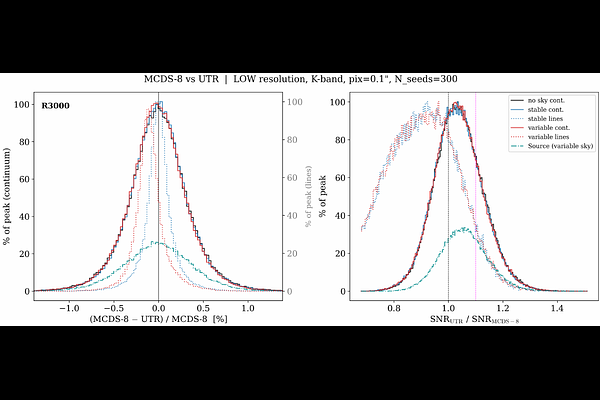
AbstractMany modern near-infrared instruments employ HAWAII-2RG (H2RG) detectors with integration times that can reach 300-600s. Up-the-ramp (UTR) sampling offers advantages over Fowler sampling, including superior cosmic ray rejection and extended dynamic range, but requires fitting linear ramps from 30-60 reads. Ground-based K-band sky brightness has been reported to vary by 3-10% on timescales of minutes, potentially introducing systematic errors and compromising photometric accuracy. Additionally, UTR data formats involve higher-dimensional FITS files with larger file sizes impacting observatory operations. We present a feasibility study using the GIRMOS Data Simulator with high-fidelity flux budgets and empirical K-band sky variations estimated from Gemini-NIRI at 10-20s cadence. Using a Monte Carlo approach we assess whether linear ramp fitting remains viable under variable sky conditions, quantify SNRs and systematic biases, and report nightly data volume estimates. Our results show that the advantages of the UTR readout hold for read-noise-limited targets placed in the inter-line regions, translating into 4-10% savings in observing time. Over the sky emission lines, UTR fitting remains possible but its performance is compromised, both by a degradation in SNR and by a high rate of pixels falsely flagged by the CR rejection algorithm. Both effects are driven by the higher signal level rather than by sky variability and the latter could be mitigated by adapting CR rejection thresholds to the local signal level. These findings address how ground-based conditions affect UTR implementation in near-infrared spectrographs, with GIRMOS as a concrete case study.