Ultraviolet Reflected-Light Spectroscopy of Modern Earth Analogs with Starshade Observations

Ultraviolet Reflected-Light Spectroscopy of Modern Earth Analogs with Starshade Observations
Zahra Ahmed, Stuart Shaklan, Mario Damiano, Armen Tokadjian, Edward W. Schwieterman, Simone D'Amico
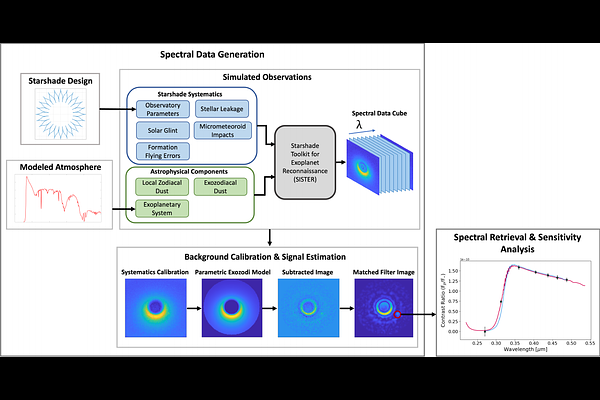
AbstractCharacterizing rocky, habitable zone planets in reflected light is a key science objective for future direct imaging missions, and the ultraviolet (UV) is uniquely suited for supporting the characterization of Earth-like atmospheres. The Hartley-Huggins ozone band at $0.25 ~μ\mathrm{m}$ remains detectable at low spectral resolution down to $0.1\%$ PAL $\mathrm{O}_2$, providing a sensitive proxy for oxygen-bearing chemistry even for Proterozoic-like atmospheres where the visible and near-infrared $\mathrm{O}_2$ features become inaccessible. This work uses an end-to-end framework for UV starshade spectroscopy of modern Earth analogs that integrates high-fidelity observation simulation, conservative post-processing, and Bayesian spectral retrieval to quantify ozone detection significance. The framework is applied across 108 simulated scenes spanning a range of planet phase angles, system inclinations, and exozodiacal dust densities. The results establish that robust ozone detection with UV-only, $R=7$ reflected light spectroscopy requires a photometric $\mathrm{SNR} \sim 30$. UV starshade observations with the Habitable Worlds Observatory achieve this threshold within 3-day integrations for solar-type systems at 10 parsecs with inclinations up to $60^\circ$ at favorable phases ($\leq 90^\circ$). Above this SNR threshold, ozone detections are robust to systematic bias from imperfect exozodi calibration within $\sim30\%$, and the median retrieved ozone abundance remains accurate to within one order of magnitude of the true value.