Weight loss increases adipose dendritic cells, non-classical antigen presenting proteins, and cytotoxic effector cells

Weight loss increases adipose dendritic cells, non-classical antigen presenting proteins, and cytotoxic effector cells
Khan, W.; Kapadia, M.; Mancera, E.; LaVoy, E. C.; Wu, H.; Caslin, H. L.
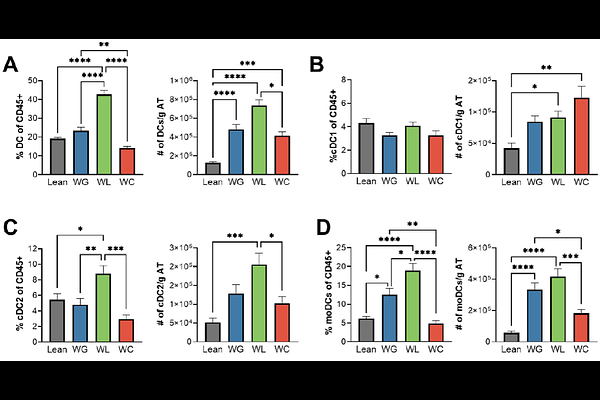
AbstractWeight cycling (i.e. cycles of weight gain, loss, and regain) is a growing health concern that has been shown to worsen risk of diabetes beyond that of obesity. Dendritic cells play a causal role in obesity-associated inflammation and metabolic disease. However, whether dendritic cells are impacted by weight cycling is not known. Here, we aimed to test the hypothesis that antigen presentation increases in dendritic cells with weight cycling. C57Bl/6J male mice were put on nutrient-matched low-fat or high-fat diets to elicit lean, weight gain, weight loss, and weight cycled groups. Adipose tissue immune cell populations and proteins related to signal 1, 2, and 3 of antigen presentation were analyzed by single cell-RNA sequencing and flow cytometry. Total adipose tissue dendritic cells, conventional type I and II dendritic cells, and monocyte-derived dendritic cells all increased with weight loss. Regarding major histocompatibility complex (MHC) protein expression, non-classical MHCIb proteins (Qa1, Qa2 and CD1d) were also highest in the weight loss group. Dendritic cells expressing the costimulatory molecule CD86 and the cytokine TNF were highest in the weight loss group. Finally, we assessed effector immune cell populations in the adipose tissue to understand the functional role of antigen presentation. CD8+ T cells, natural killer (NK) T cells, and NK cells also increased consistently with weight loss, but showed evidence of exhaustion. In sum, weight loss, but not weight cycling expands dendritic cells, increases signals for non-classical antigen presentation, and expands CD8+ T cells, NKT cells, and NK cells in the adipose tissue.