Sulfur fractionation in coronal plumes as observed by Solar Orbiter/SPICE

Sulfur fractionation in coronal plumes as observed by Solar Orbiter/SPICE
Slimane Mzerguat, Miho Janvier, Eric Buchlin, Deborah Baker, Andy S. H. To, David M. Long, Natalia Zambrana Prado
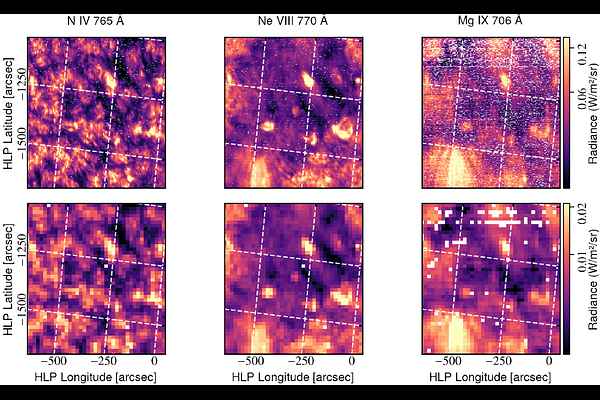
AbstractCoronal plumes are bright, narrow structures rooted in coronal holes that contribute to the solar wind. Their composition, particularly elemental fractionation as a function of first ionization potential (FIP), provides diagnostics of plasma properties and magnetic connectivity. Earlier plume studies of fractionation using low-FIP elements reached conflicting conclusions. Intermediate-FIP elements may provide additional diagnostic insight, since their fractionation is thought to involve processes beyond those affecting low-FIP species. We investigate sulfur (intermediate-FIP element) in plumes to assess the presence of fractionation, its evolution, and its relation to wave activity. We analyzed Solar Orbiter observations of two plumes in an equatorial coronal hole during March--April 2024, using Spectral Imaging of the Coronal Environment (SPICE) to derive the sulfur-to-nitrogen ratio. EUV imaging and magnetograms provided additional context. Data were processed with the open-source Python tool Spectral Analysis Fitting Framework and Reduction of Noise (SAFFRON). Both plumes showed sulfur fractionation that remained constant within uncertainties. The fractionated plasma was co-located with strong magnetic footpoints, in contrast with the surrounding interplume plasma. These results provide the evidence for sulfur fractionation in plumes and suggest, consistent with the ponderomotive force model, wave dynamics in the chromosphere as a driver.