Unveiling the enigma of the Nakashima-Deguchi object (IRAS 19312+1950): a candidate Orion KL analog

Unveiling the enigma of the Nakashima-Deguchi object (IRAS 19312+1950): a candidate Orion KL analog
Y. Gong, K. M. Menten, T. Kamiński, F. Schuller, F. Navarete, A. Belloche, P. Schilke, F. Wyrowski
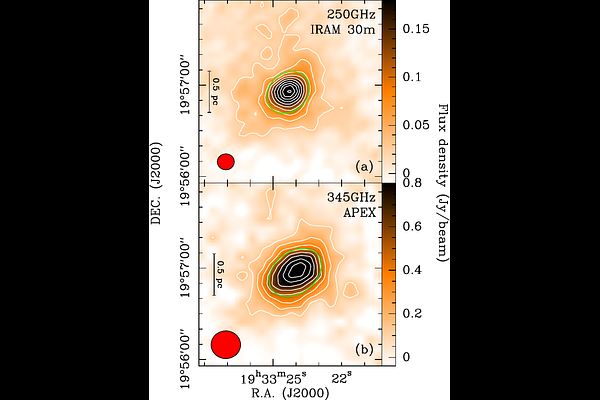
AbstractThe Nakashima-Deguchi object (NDO; aka IRAS 19312+1950) has been recognized as an enigmatic object, exhibiting characteristics of both an evolved star and a star-forming region. However, the actual nature of this object remains a topic of ongoing debate. We conducted observations of this object in (sub)millimeter continuum and molecular line emission using the IRAM-30m and APEX telescopes as well as the SMA. Based on SED fitting of single-dish continuum observations, we determined that the cloud hosting NDO has a dust temperature of $25\pm2$ K, a source-averaged (24$^{\prime\prime}$) H$_2$ column density of $(4.4\pm 0.6) \times 10^{22}$ cm$^{-2}$, a dust emissivity index of $1.7\pm0.2$, and a total gas mass of $220\pm21 M_{\odot}$. SMA continuum observations resolve the cloud into at least four dust continuum cores. The centrally peaked core MM1, associated with an SiO maser, is the primary mass reservoir. Single-dish spectroscopic observations of NDO led to the detection of 59 spectral lines attributed to 12 species and their isotopologues. This includes the first detection of deuterated molecules, DCO$^{+}$, DCN, DNC, and HDCO, indicating substantial deuterium abundance. SMA spectroscopic observations detected 75 spectral lines toward MM1, assigned to 12 species and their isotopologues. These lines exhibit diverse morphologies on a scale of $\sim$0.1 pc, likely due to outflow feedback. The observed high-velocity outflow is inconsistent with a spherical morphology and rather resembles a wide-angle bipolar outflow. The presence of deuterated species, and the overall large mass of the complex, the surrounding material of NDO appears more naturally associated with a star-forming environment than with a purely evolved-star scenario. Our investigations led us to postulate that this enigmatic object may represent an Orion KL analog about ten times farther away.