Anoxia selects for high fitness biofilms and increased antibiotic resistance in Pseudomonas aeruginosa

Anoxia selects for high fitness biofilms and increased antibiotic resistance in Pseudomonas aeruginosa
Bridwell, S.; Bahu, M.; Okuagu, C.; Marshall, C. W.
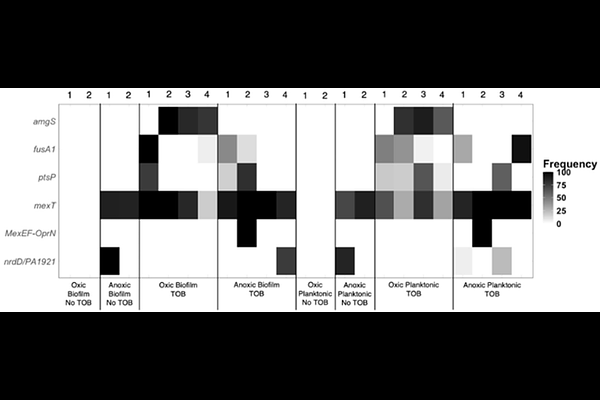
AbstractAntibiotic resistance is a growing global health crisis, yet resistance is almost exclusively quantified under aerobic laboratory conditions that fail to reflect the complex microenvironments bacteria encounter during infection. Many clinically important infection sites, such as airways of individuals with cystic fibrosis or chronic wounds, are microaerobic to anoxic. To address this, we investigated how anoxia alters antibiotic resistance determinants, hypothesizing that anaerobic metabolism might change the fitness effects and selection of resistance mutations. We used experimental evolution to propagate Pseudomonas aeruginosa populations for approximately 200 generations under conditions differing in oxygen availability (oxic vs. anoxic), growth mode (biofilm vs. planktonic), and tobramycin (TOB) exposure (subinhibitory increasing to inhibitory concentrations). Subinhibitory exposure was sufficient to achieve resistance 2-4x greater than ancestral levels, with anoxic populations consistently showing higher minimum inhibitory concentrations than oxic comparisons. Resistance developed through condition-dependent genomic targets: mutations in amgS were selected in oxic populations, while fusA1 and ptsP mutations arose across all conditions. Notably, mexT mutations were nearly universally selected, particularly under anoxic or tobramycin-exposed conditions. mexT inactivation may also enhance virulence through altered quorum sensing and increased rhamnolipid production. Anoxic populations additionally exhibited significantly increased biofilm formation, some exceeding 1000% of ancestral levels, reduced twitching motility driven by type IV pilus gene mutations, and greater competitive fitness. Together, these findings demonstrate that oxygen availability shapes resistance evolution in P. aeruginosa, with the anoxic environment selecting for a more virulent, sessile, and antibiotic-resistant phenotype.