Tirzepatide improves pancreatic β-cell function in mice and patients with type 2 diabetes.

Tirzepatide improves pancreatic β-cell function in mice and patients with type 2 diabetes.
Li, Z.; Guo, J.; Cheng, Y.; Zhang, T.; Luo, X.; Zhang, S.; Ren, Q.; Wu, Z.; Chen, N.; Li, M.
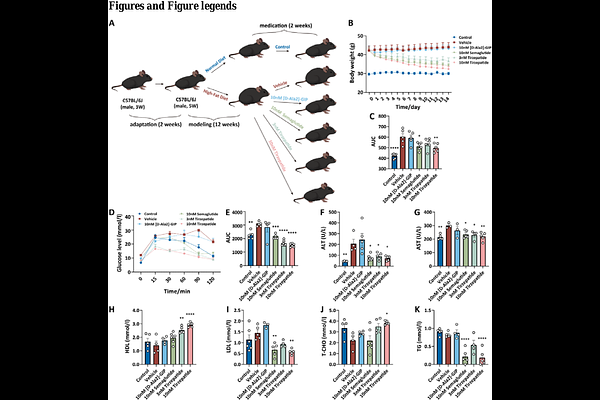
AbstractThe dual incretin receptor agonist tirzepatide improves {beta} cell function in T2D patients, but the underlying mechanism remains unclear. This study aimed to elucidate the molecular pathway through which tirzepatide restores {beta} cell functional improvement. High-fat diet (HFD)-fed C57BL/6J mice were treated with vehicle, a GIP analogue, semaglutide or tirzepatide. Tirzepatide significantly reduced body weight and improved glucose tolerance in HFD fed mice without altering {beta} cell mass, proliferation, or apoptosis. Instead, tirzepatide reversed {beta} cell dedifferentiation, as indicated by reduced ALDH1A3 expression and restored levels of the identity transcription factors PDX1 and MAFA. Single-cell RNA sequencing (scRNA seq) and in vitro studies revealed that tirzepatide up regulated FOXO1, reactivating the FOXO1 PDX1/MAFA axis. In T2D patients, tirzepatide improved glycemic control, reduced insulin demand, increased HOMA {beta}, and decreased HOMA IR. Improvement in HOMA {beta} correlated positively with baseline insulin resistance. Hence, our study suggested that tirzepatide restores {beta} cell function in T2D by reprogramming stressed {beta} cells and re establishing {beta} cell identity through FOXO1 dependent transcriptional reactivation. These findings provide a mechanistic basis for the superior efficacy of dual incretin receptor agonism in T2D management.