The WEAVE acquisition and guiding software: pattern recognition-based acquisition and multi-fibre guiding

The WEAVE acquisition and guiding software: pattern recognition-based acquisition and multi-fibre guiding
Emanuel Gafton, Gavin B. Dalton, Don Carlos Abrams, Jure Skvarč, Sergio Picó, Lilian Domínguez-Palmero, Illa R. Losada, Sarah Hughes, Neil O'Mahony, Frank J. Gribbin, Andy Ridings, David L. Terrett, Cecilia Fariña, Chris R. Benn, Esperanza Carrasco, P. Joel Concepción Hernández, Kevin Dee, Rafael Izazaga, Shoko Jin, Ian J. Lewis, J. Alfonso L. Aguerri, Gonzalo Páez
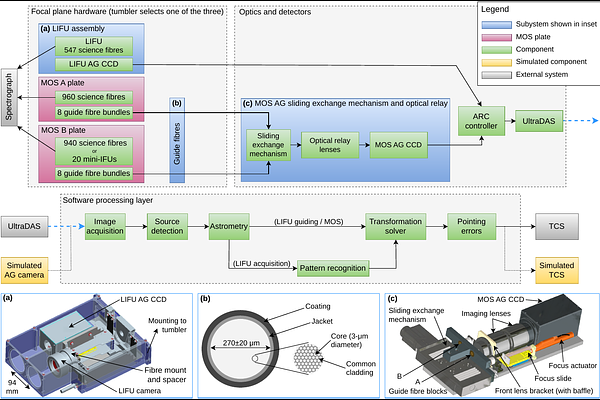
AbstractWe present the architecture, implementation, and on-sky validation of the fully automated acquisition and guiding system (AG) developed for the WEAVE instrument on the William Herschel Telescope. The AG operates in two distinct modes, corresponding to the observing modes of WEAVE. For the large integral field unit (LIFU), an off-axis imaging guider is used, for which we have devised an automatic acquisition method based on pattern recognition of stellar asterisms matched against Gaia predictions. For the multi-object spectrograph (MOS) and the mini-integral field units (mIFU), a multi-fibre guider uses up to eight coherent image guide fibre bundles to derive and apply continuous corrections in azimuth, altitude, and rotation. The system performs complete astrometric calculations, including atmospheric differential refraction and instrument flexure, for each guide frame, enabling accurate target placement and stable closed-loop guiding in all configurations. To support development, commissioning, and operational validation, we have also built a high-fidelity simulation mode that reproduces the behaviour of the telescope control system and of the AG cameras, and we release the standalone camera simulator as open-source software. Using two years of routine WEAVE operations spanning commissioning and early survey phases, we present a statistically robust characterization of AG performance, demonstrating that both modes meet design requirements and are ready for sustained survey operations.