The effect of microstructural variations in tendon and ligament on diffusion tensor MRI

The effect of microstructural variations in tendon and ligament on diffusion tensor MRI
Focht, M. D. K.; Borole, A.; Moghaddam, A. O.; Wagoner Johnson, A. J.; Pineda Guzman, R. A.; Damon, B. M.; Naughton, N. M.; Kersh, M. E.
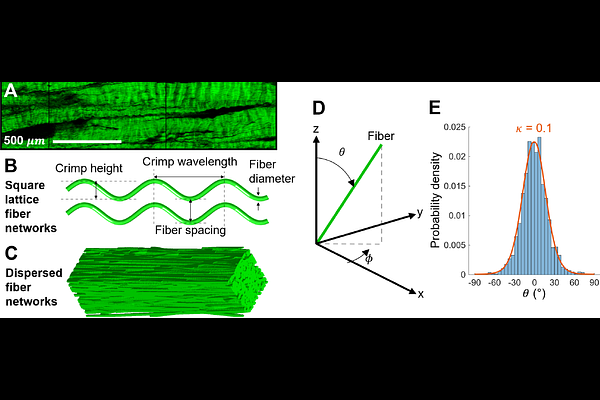
AbstractThe fibrous microstructure of tendons and ligaments is an important determinant of their mechanical behavior and integrity. Diffusion tensor imaging (DTI) is a magnetic resonance imaging (MRI) technique that enables the inference of microstructural features within fibrous tissues and has recently been used to characterize the microstructure of dense connective tissues such as tendon and ligament. However, the effect of microstructural variations in tendon and ligament on DTI metrics remains unclear. To address this gap, we simulated diffusion MRI of second harmonic generation (SHG) image-informed square lattice fiber networks to determine which microstructural features have the strongest influence on DTI metrics. Then, we performed a second set of diffusion MRI simulations for randomly dispersed fibers within synthetic tendon volumes to relate DTI metrics to the influential microstructural features, including fiber dispersion. All DTI metrics were insensitive to collagen fiber crimp. Fiber dispersion did not affect mean diffusivity, decreased axial diffusivity, increased radial diffusivity, and decreased fractional anisotropy. These results provide valuable insight into the relationships between DTI metrics and microstructural properties of tendon and ligament, which is particularly relevant for inferring microstructural changes in impaired tissue using DTI. Furthermore, our findings are an important step in the translation of DTI for clinical and computational studies of dense connective tissues such as tendon and ligament.