Latitudinal dependence of stability trends in marine plankton in the Cenozoic

Latitudinal dependence of stability trends in marine plankton in the Cenozoic
Morrison, M. L.; Woodhouse, A.; Swain, A.
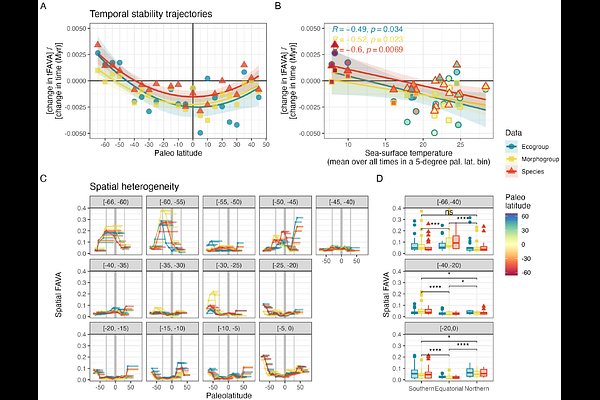
AbstractThe temporal stability and spatial heterogeneity of global marine ecosystems under changing climates reveal how biodiversity persists or collapses. However, the deep-time evolution of these phenomena remains poorly understood. We reconstructed the stability landscape of pelagic plankton from the Cretaceous-Paleogene extinction to the present. We find that the Cenozoic was a period of punctuated volatility with high turnover post-extinction and during the Late Neogene cooling. Spatially resolved analysis revealed latitude-dependent trends: equatorial regions stabilized over time, whereas polar communities, especially in the Southern Ocean, destabilized. Equatorial regions homogenized from initially high heterogeneity, whereas polar communities showed the opposite pattern, including a latitudinal seesaw of spatial heterogeneity over the past 30 million years. These findings illuminate temporal stability and spatial heterogeneity dynamics across geologic timescales.