Interpretation of 21 cm Auto Power Spectrum Measurement at $z\sim 1$ by the Canadian Hydrogen Intensity Mapping Experiment

Interpretation of 21 cm Auto Power Spectrum Measurement at $z\sim 1$ by the Canadian Hydrogen Intensity Mapping Experiment
CHIME Collaboration, Mandana Amiri, Kevin Bandura, Arnab Chakraborty, Zhuo Yu Brian Chu, Matt Dobbs, Simon Foreman, Liam Gray, Mark Halpern, Gary Hinshaw, Albin Joseph, Nolan Kruger, Joshua MacEachern, Kiyoshi W. Masui, Juan Mena-Parra, Laura Newburgh, Tristan Pinsonneault-Marotte, Alex Reda, Shabbir Shaikh, Seth R. Siegel, Yukari Uchibori, Keith Vanderlinde, Haochen Wang, Dallas Wulf
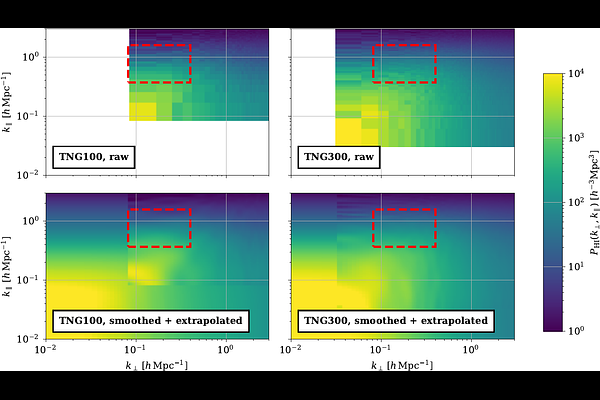
AbstractObservations with the Canadian Hydrogen Intensity Mapping Experiment (CHIME) have been used to measure the 21 cm intensity mapping auto power spectrum, at $z\sim 1$, over a frequency range from 608.2 MHz to 707.8 MHz at wavenumbers $0.4~h~{\rm Mpc}^{-1} \lesssim k \lesssim 1.5~h~{\rm Mpc}^{-1}$. In this paper, we present the results of two different approaches to interpreting this measurement. In the first approach, we use a parametric power spectrum model to constrain an amplitude parameter, defined as $\mathcal{A}^2_{\rm HI} \equiv 10^6 Ω_{\rm HI}^2(b^2_{\rm HI}+\langle f μ^2\rangle)^2$, where $Ω_{\rm HI}$ is the cosmological density parameter for atomic hydrogen ($\rm HI$), $b_{\rm HI}$ is the linear bias for $\rm HI$, and $\langle f μ^2\rangle$ incorporates the dominant large-scale impact of redshift-space distortions on the angle-averaged power spectrum. Imposing an additional prior on either $Ω_{\rm HI}$ or $b_{\rm HI}$, based on values in the literature, allows us to break the pairwise degeneracy between those two parameters. In the second approach, we compare CHIME's measurement with predictions for the power spectrum of $\rm HI$ from the IllustrisTNG simulations, finding that the measurement disagrees with the TNG100 run at $3.1σ$ and the TNG300 run at $4.0σ$. This disagreement is most likely attributable to the strength of nonlinear redshift-space clustering of $\rm HI$ in the simulations, rather than the total abundance of $\rm HI$, and invites further investigation of the physical processes in the simulations that determine the behavior of $\rm HI$ at nonlinear scales. These results exemplify the ability of 21 cm intensity mapping to provide astrophysical information using measurements at nonlinear scales.