Combination of engineered cell type-specific promoters and a high-efficiency AAV capsid restores hearing in adult DFNB1 mice model with demonstrated safety in nonhuman primate

Combination of engineered cell type-specific promoters and a high-efficiency AAV capsid restores hearing in adult DFNB1 mice model with demonstrated safety in nonhuman primate
Hu, S. W.; Ye, C.; Geng, G.; Zeng, Y.; Bao, Y.; Zhang, S.; Cui, C.; Zhang, Y.; Mu, D.; Wang, D.; Fan, X.; Chen, Z.; Zhu, B.; Han, S.; Wang, H.; Su, Q.; Han, L.; Hu, X.; Tang, H.; Wang, X.; Sun, Z.; Yu, H.; Deng, H.; Cai, Z.; Li, H.; Yang, H.; Sun, G.; Shu, Y.
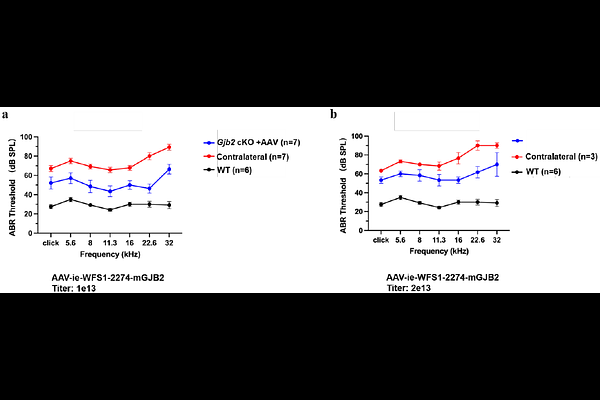
AbstractA major challenge in gene therapy for GJB2-related hearing loss (DFNB1), the most common form of hereditary deafness, is achieving efficient and precise connexin 26 delivery. Herein, we engineered two cell type-specific promoters (GJB2-1 and WFS1-2274) and developed an AAV capsid, AAV-MAS012, with enhanced transduction efficiency in mature cochlear cells. Our AAV-mediated gene therapy systems restored hearing of low-to-mid-frequencies in newborn Gjb2 cKO mice to wild-type levels and maintained for 45 weeks. Additionally, our therapeutic systems restored low-to-mid-frequencies hearing function to wild-type levels in adult Gjb2 cKO mice. A humanized version of the therapy, AAV-MAS012-WFS1-2274-hGJB2, rescued hearing function in two distinct Gjb2-deficient mouse models, and demonstrated a favorable safety profile in nonhuman primates. This study represents the first successful hearing restoration in adult Gjb2-deficient mice. The significant therapeutic efficacy of the humanized gene therapy system shows great potential for clinical translation in DFNB1 patients.