Resistance to the conjugation inhibitor AZT reveals mating partner incompatibility during plasmid transfer

Resistance to the conjugation inhibitor AZT reveals mating partner incompatibility during plasmid transfer
Erdem, E. D.; Elena, A. X.; Fang, P.; Berendonk, T. U.; Klümper, U.
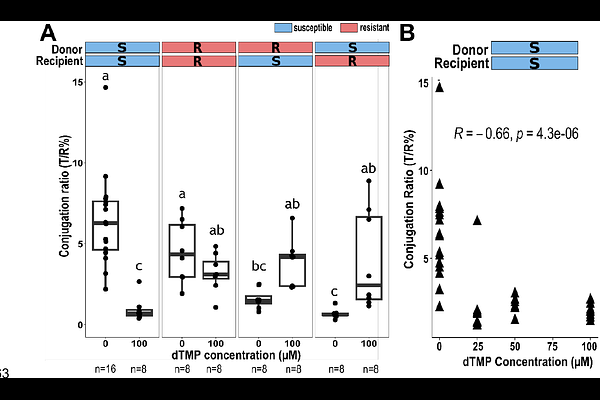
AbstractPlasmid-mediated dissemination of antibiotic resistance genes (ARGs) is a major driver of antimicrobial resistance (AMR). The nucleoside analogue zidovudine (azidothymidine, AZT) has emerged as a promising conjugation inhibitor, yet the consequences of AZT resistance for subsequent plasmid transfer remain poorly understood. Here, we investigated how AZT resistance in donor and recipient bacteria influences conjugative plasmid transfer. Independent AZT-resistant mutants arose through nonsense mutations in two distinct thymidine metabolism genes, yjjG and tdk. Consistent with previous studies, AZT suppressed plasmid transfer 10-fold between susceptible mating partners, whereas resistance in both partners restored transfer despite continued AZT exposure. Unexpectedly, plasmid transfer was markedly reduced even in the absence of AZT when only one mating partner carried a resistance mutation, declining by up to 11.5-fold regardless of whether the resistant strain was the donor or the recipient. This mixed-resistance phenotype was rescued by supplementation with dTMP, a thymidine pathway metabolite downstream of both resistance-associated mutations, thereby increasing plasmid transfer by up to 5.88-fold and restoring transfer to levels comparable to those of susceptible-susceptible matings. In contrast, excess dTMP reduced conjugation between susceptible partners, supporting a broader role for balanced nucleotide metabolism in determining conjugation efficiency. Together, our findings identify nucleotide metabolism as a previously unrecognised determinant of conjugative plasmid transfer and suggest that the long-term efficacy of conjugation inhibitors such as AZT will depend not only on the evolution of resistance, but also on how resistance reshapes the physiological compatibility of bacterial mating partners.