A capture-handling-restraint protocol elicits short-term stress responses in female and male parental wild great tits (Parus major) but has little impact on reproductive success

A capture-handling-restraint protocol elicits short-term stress responses in female and male parental wild great tits (Parus major) but has little impact on reproductive success
Frohlich, F.; Mentesana, L.; Deimel, C.; Hau, M.
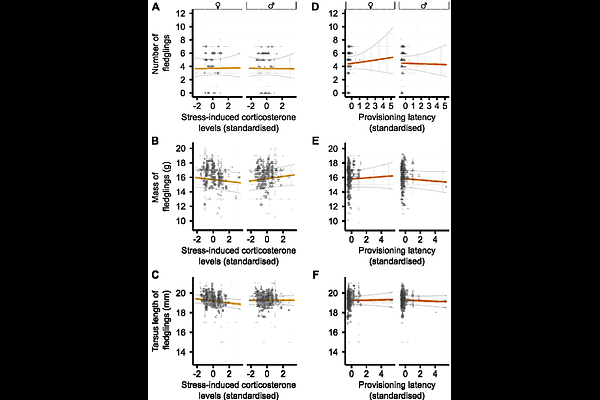
AbstractCapturing and handling wild animals is essential for ecological and evolutionary research, yet their effects on physiology, behaviour, and reproductive success remain poorly understood. We investigated short- and longer-term consequences of a capture-handling-restraint protocol in wild great tits (Parus major) over three breeding seasons. To assess short-term responses, we measured circulating corticosterone, a metabolic hormone that responds to unpredictable challenges, and automatically recorded provisioning behaviour. We also explored whether environmental and individual traits were related to provisioning latency (i.e., time to resume provisioning after capture). To evaluate longer-term effects, we monitored provisioning in the days following capture and related it to reproductive success (fledgling number and body condition). We predicted that longer handling would increase stress-induced corticosterone and provisioning latency, that these variables would be positively correlated, and that higher corticosterone and longer latencies would be associated with lower reproductive success. After capture, great tits showed elevated corticosterone and delayed provisioning. Contrary to our predictions, handling duration was negatively associated with stress-induced corticosterone in males (but not females) and did not affect provisioning latency. Provisioning latency was unrelated to corticosterone, environmental, or individual variables. Following capture, parents resumed provisioning, and short-term responses had little influence on reproductive success. We show that parental behaviour and physiology are affected by capture restraint protocols on the short term, but offspring condition and survival are not. However, these results should be interpreted cautiously, as our study lacks an uncaptured control group. Our findings highlight that evaluating welfare impacts requires rigorous study design incorporating both immediate and longer-term behavioural and fitness effects.