AutoMem: Automated Learning of Memory as a Cognitive Skill

AutoMem: Automated Learning of Memory as a Cognitive Skill
Shengguang Wu, Hao Zhu, Yuhui Zhang, Xiaohan Wang, Serena Yeung-Levy
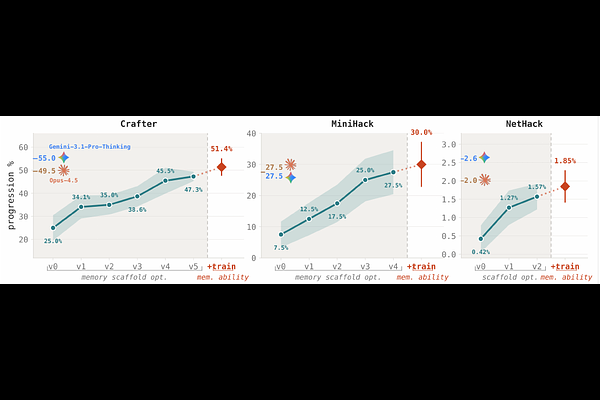
AbstractMemory expertise is a learned skill: knowing what to encode, when to retrieve, and how to organize knowledge--a capacity known in cognitive science as metamemory. We bring this perspective to LLMs by treating memory management as a trainable skill. We promote file-system operations to first-class memory actions alongside task actions, letting the model itself decide how to manage its memory. This memory skill improves along two axes: the structure that supports it (prompts, file schemas, action vocabulary), and the proficiency of the model exercising it. Both axes resist manual optimization: episodes in long-horizon tasks run for thousands of steps, and a single memory mistake can hide long before it surfaces, making human review of full trajectories impractical. We introduce AutoMem, a framework that automates both axes. In the first loop, a strong LLM reviews complete agent trajectories and iteratively revises the memory structure that shapes how the agent interacts with its memory files. In the second loop, the agent's own good memory decisions are identified from many episodes and used as training signal to sharpen the model's memory proficiency directly. Across three procedurally generated long-horizon games (Crafter, MiniHack, and NetHack), optimizing memory alone--without modifying the model's task-action behavior--improved the base agent's performance ~2x-4x, bringing a 32B open-weight model competitive with frontier systems such as Claude Opus 4.5 and Gemini 3.1 Pro Thinking. Our results show that memory management is an independently learnable skill, and a high-leverage objective yielding large gains on long-horizon tasks.