Asgard/NOTT: L-band nulling interferometry at the VLTI -- III. The mid-infrared integrated optics beam combiner for NOTT

Asgard/NOTT: L-band nulling interferometry at the VLTI -- III. The mid-infrared integrated optics beam combiner for NOTT
A. Sanny, L. Labadie, S. Gross, K. Barjot, R. Laugier, G. Garreau, M. -A. Martinod, D. Defrère, M. J. Withford
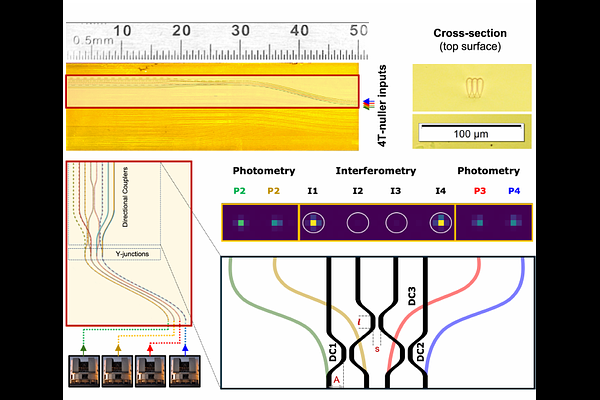
AbstractThe NOTT visitor instrument at the VLTI will characterize hot exozodiacal dust and young Jupiter-like planets at the water snowline via L' band nulling interferometry. The beam combination will be achieved by a four-telescope integrated optics beam combiner (IOBC) that fulfills specific requirements. Our goal was to manufacture the mid-infrared IOBC for NOTT based on the double-Bracewell architecture and run a detailed laboratory characterization in the L' band. We focus on the achievable raw and self-calibrated nulling ratios. We use a double Michelson interferometer to produce four broadband coherent beams simulating the four telescopes of the VLTI and perform broadband nulling at room temperature. We analyze the modal, chromatic, and polarization behavior of the IOBC, and measure its total throughput. We were able to manufacture a single-mode four-telescope double-Bracewell IOBC in GLS mid-infrared transparent glass using Ultrafast Laser Inscription. We show that the directional couplers forming the four-telescope IOBC (4T-nuller) have an achromatic splitting ratio across the band 3.65-3.85 um with a 40/60 and 50/50 splitting for the side couplers and the central coupler, respectively. We report a total throughput of 37%, including the Fresnel losses that will be mitigated with anti-reflection coatings, and quantify differential birefringence. Operating at room temperature, with 200 nm bandwidth centered at 3.8 um and without polarization control, we measure an average raw null of 8.13+/-0.03x10-3 and a self-calibrated null of 1.14+/-0.01x10-3. Finally, we show that a theta^6 broad null can be experimentally reproduced in these conditions. This is, to our knowledge, the first measurement of a broadband L' deep null obtained with a four-telescope integrated optics beam combiner. The next step foresees testing the 4T-nuller in cryogenic conditions.