Chromospheric and photospheric properties of sunspots as inferred from Stokes inversions under magneto-hydrostatic and non-local-thermodynamic equilibrium

Chromospheric and photospheric properties of sunspots as inferred from Stokes inversions under magneto-hydrostatic and non-local-thermodynamic equilibrium
A. Vicente Arevalo, J. M. Borrero, I. Milic, A. Pastor Yabar, I. Kontogiannis, A. G. M. Pietrow
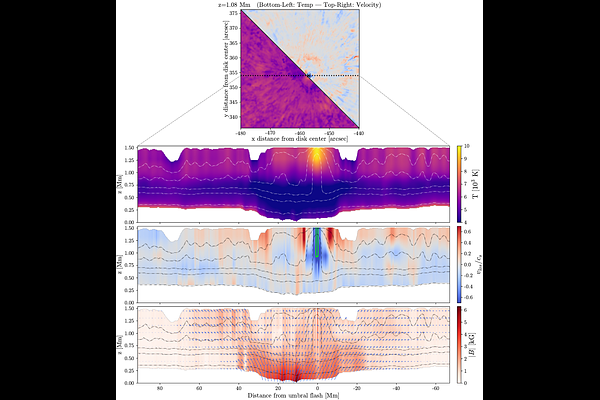
AbstractSunspots are crucial for exploring how magnetic fields and plasma flows interact in the solar atmosphere, spanning from the stable photosphere to the shock-dominated chromosphere. To determine the thermal, magnetic, and kinematic properties of a sunspot across these layers and to investigate transient phenomena like umbral flashes, we analyzed high-resolution spectropolarimetric data from the CRISP instrument at the Swedish Solar Telescope. By applying the FIRTEZ inversion code, which incorporates non-local thermodynamic equilibrium (non-LTE) and 3D magneto-hydrostatic (MHS) equilibrium, to full Stokes measurements of multiple spectral lines (Mg I, Na I, Fe I, and Ca II), we successfully mapped the atmospheric parameters in a 3D domain. Our analysis reveals that the photospheric Evershed flow actually reverses into an inflow in the upper photosphere. In contrast, the surrounding moat flow persists as an outflow at similar heights, indicating that it is not a direct continuation of the Evershed flow. Furthermore, observations of an umbral flash event uncovered supersonic upflows (Mach numbers $\|M\|\geq 1.5$) and thermodynamic conditions characteristic of shock fronts. Ultimately, combining 3D MHS equilibrium and non-LTE effects across multiple spectral lines proves highly effective for simultaneously constraining parameters in both the photosphere and chromosphere. These findings provide clear evidence of shock dynamics in umbral flashes, supporting the theory that converging supersonic flows act as the primary driving mechanism while shifting optical depth iso-surfaces.