Native-resolution retrievals of VHS 1256-1257 b spanning the JWST/NIRSpec wavelength range: Chemical composition of a partially cloudy atmosphere

Native-resolution retrievals of VHS 1256-1257 b spanning the JWST/NIRSpec wavelength range: Chemical composition of a partially cloudy atmosphere
S. de Regt, N. Whiteford, B. E. Miles, S. Gandhi, D. González Picos, I. A. G. Snellen
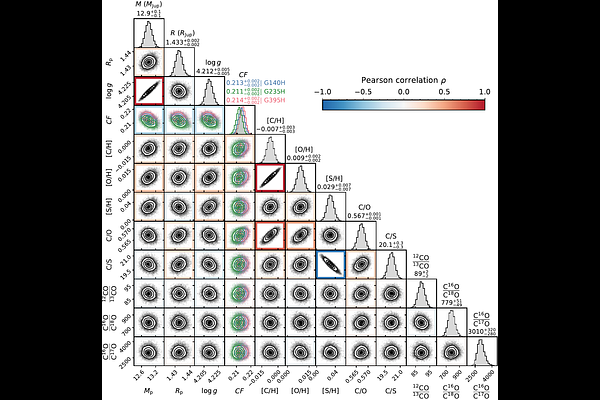
AbstractThe wide wavelength coverage and sensitivity offered by JWST enable detailed analyses of extrasolar atmospheres. At its highest resolution (R~2700), NIRSpec measures the absorption from atomic, molecular, and isotopic gases whose abundances reflect the chemical composition of accreted material, making them key tracers of the formation environment. Orbiting an inner M-dwarf binary at a wide separation, the planetary-mass companion VHS 1256 b is one of the most variable sub-stellar objects known, with flux variations of 10-30%. We analyse the 0.97-5.27 micron NIRSpec ERS spectra of VHS 1256 b, update the data reduction and employ petitRADTRANS for atmospheric retrievals at the native spectral resolution. We model a partially cloudy atmosphere in chemical disequilibrium and fit directly for the elemental and isotopic abundances. Our best-fitting model closely matches the observations, bringing the residuals down to ~1%. The results are cautiously interpreted as degeneracies can bias some parameter constraints, most notably the mass and radius. Still, the retrieval finds a partial cloud deck covering ~79% of the visible surface, with a clearer column dominating at short wavelengths. Small changes of 1-3% can account for the high observed variability. From the many detected gases, we infer a metallicity, C/O ratio, and 12C/13C ratio in line with a solar composition, while the 18O isotope appears depleted relative to the Sun and local ISM. The isotope abundances are significantly lower than previous studies suggested, underlining the importance of our updated spectra. The 18O-depletion defies our understanding of the likely top-down formation. Our interpretation of the retrieved composition is complicated further by the lack of host star abundances. Nevertheless, this study demonstrates the value of panchromatic, native-resolution retrievals for characterising complex extrasolar atmospheres.