Stage-dependent tau post-translational modifications map the spatiotemporal progression of Alzheimer's disease

Stage-dependent tau post-translational modifications map the spatiotemporal progression of Alzheimer's disease
Vanparys, A. A. T.; Balty, C.; Johanns, M.; Kyalu Ngoie Zola, N.; Herinckx, G.; Van Calsteren, M.; Suelves, N.; Woodard, J. L.; Vertommen, D.; Kienlen-Campard, P.; Hanseeuw, B. J.
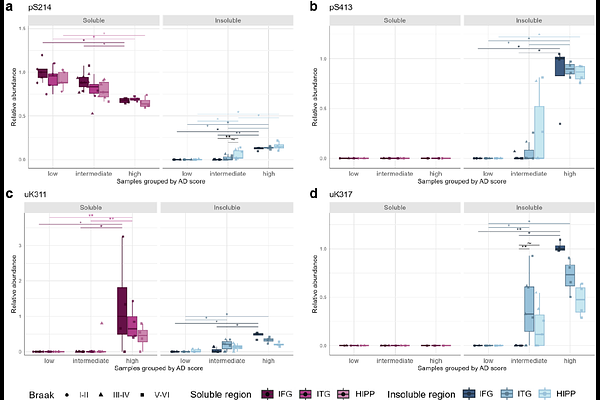
AbstractAlzheimer's disease (AD) is defined by progressive tau aggregation, yet the molecular events driving this process remain poorly understood. Post-translational modifications (PTMs) are key regulators of tau biology and potential biomarkers of disease progression. Using immunoprecipitation-mass spectrometry and absolute quantification of tau isoforms, we profiled tau PTMs in soluble and insoluble brain fractions. We studied multiple brain regions (hippocampus, inferior temporal and frontal gyri), representing regions affected at different stages of pathology, from human donors spanning the AD spectrum and staged by ABC neuropathological scoring. We uncovered a stage-dependent PTM landscape across AD progression: early phosphorylation changes, including pT217 and pS262, precede later ubiquitination events, such as uK311, associated with tau aggregation. We also identified PTMs negatively correlated with aggregation, including mK258, suggesting potential protective roles. These findings refine our understanding of the spatiotemporal evolution of tau biochemistry and offer mechanistic and translational insights into AD tauopathy.