Bridging human and plant adaptations for climate resilience

Bridging human and plant adaptations for climate resilience
Favretto, N.; Tan, H. L.; Brain, G.; Ezer, D.
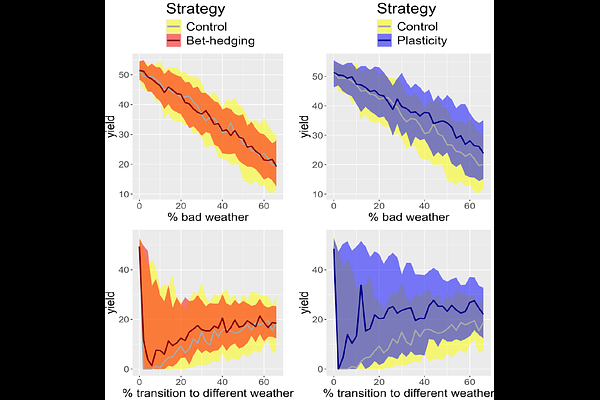
AbstractClimate change is reshaping agriculture through both gradual shifts and increasingly unpredictable extremes. Plants cope using developmental plasticity and bet-hedging, but it is unclear how these biological strategies align with the ways farmers perceive and respond to climate risks. This study investigates: (1) whether farmers understand climate change as incremental trends or recurrent shocks, (2) how their adaptations parallel plant plasticity and bet-hedging, and (3) under which climate scenarios these adaptations best support yield stability. We combined qualitative research and modelling by conducting fifty semi-structured interviews with farmers, agricultural associations and public administrators across three climatically distinct Italian regions, and by developing an agent-based stochastic simulation that represents farmer-like plasticity (delayed sowing) and bet-hedging (staggered sowing) under drought and flood scenarios. Farmers described climate change as both gradual transformation and intensifying volatility. Their adaptive responses, adjusting calendars, switching crops and diversifying production, closely aligned with plant strategies, though articulated in practical rather than scientific terms. Simulation results showed that plasticity enhanced yields under systematic shifts in conditions, whereas bet-hedging reduced losses in highly variable climates characterised by frequent transitions between extremes. Together, the qualitative and modelling findings demonstrate that plant and farmer adaptation logics converge in complementary ways. Plasticity supports performance under gradual change, while bet-hedging buffers unpredictability. These insights highlight the potential for co-designed tools that link plant traits, farmer decision-making and ecological risk, strengthening climate-resilient agricultural planning and improving communication between farmers, breeders and plant scientists.