The ALMA Survey of Gas Evolution of PROtoplanetary Disks (AGE-PRO): Formaldehyde (H$_2$CO) emission and its links to disk properties

The ALMA Survey of Gas Evolution of PROtoplanetary Disks (AGE-PRO): Formaldehyde (H$_2$CO) emission and its links to disk properties
Ella Chevalier, Ke Zhang, Miguel Vioque, Nicolás T. Kurtovic, Paola Pinilla, James Miley, Dingshan Deng, John Carpenter, Carolina Agurto-Gangas, Anibal Sierra
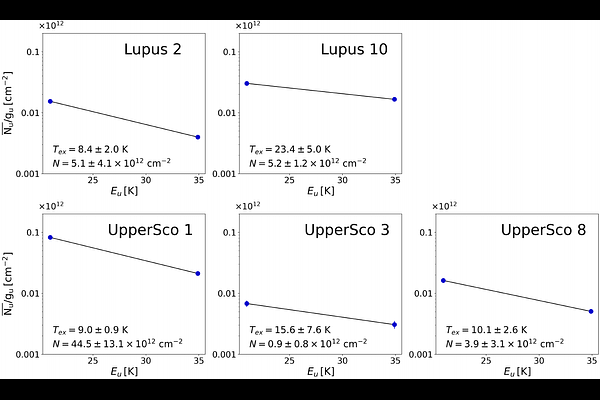
AbstractProtoplanetary disks are rotating structures of gas and dust surrounding young stars, serving as the birth places of planets. Understanding the chemical evolution of organic materials in these disks is key for tracing the origins of organics in planetary systems. Formaldehyde (H$_2$CO) is the most commonly detected organic molecule in protoplanetary disks. In this study, we investigate the emission of H$_2$CO and its link to disk properties, using a sample of 20 Class II disks in the Lupus and Upper Sco star-forming regions spanning over 1-6 Myr. We analyze the H$_2$CO lines at 218.222 and 290.623 GHz observed as part of the AGE-PRO ALMA Large Program. Within this sample we achieve a detection rate of H$_2$CO of 45% (9/20), and set robust upper limits for the non-detections. We measure the excitation temperature and column density of the H$_2$CO gas in the sources with H$_2$CO detections. We combine our sample with 13 additional disks with archival H$_2$CO detections and search for correlations between H$_2$CO properties and disk parameters. Notably, we find strong correlations between H$_2$CO line luminosity and dust radius, gas radius, dust mass, gas mass, stellar mass, and stellar luminosity. This suggests that H$_2$CO emission is brighter for extended massive dust disks where H$_2$CO can form via CO ice hydrogenation on grain surfaces. We find that the H$_2$CO excitation temperature is also correlated with stellar mass and stellar luminosity, so more massive and luminous stars could increase H$_2$CO excitation.